


Chapter 2: The Jotun Vows
Winter pressed its gray snout against the longhouse windows, gnawing ice into every seam. Frost crusted the beards of the guards outside and cracked the rushes beneath boots inside. Thralls fed the fire like starving wolves, tossing pitch-soaked logs into its maw until resin smoke hung low, thick with old grease and the sour breath of unease.
The hall had emptied of its heart.
The wagons were already gone—Varngard’s heartbeat numbed and lashed in rawhide, rolling north under Jotun guard. Twenty wagons of grain, ale, and iron. And a bride.
That was the reckoning. Human vows had bound them at dawn, thin as spiderwebs. Now came the Jotun way.
By midmorning, the feast groaned across the tables. Jarls gathered in winter finery; they wore dark wool, and colored brooches. Their wives stood behind them with eyes like polished blades, watching the monsters in their midst.
At the far end, the Jotun emissaries waited. Tall as doorframes, pale as carved bone, their stillness sculpted by another world.
One stood apart. The steward. Smoke coiled around her, rising not from the hearth but from her skin. Seemingly alive. Her eyes found Runa. Saw her. Saw through her.
Runa held the gaze. The smoke spiraled in answer.
She sat at her father’s side at the high table. The great iron-banded chair beside her remained empty. The runes once carved into its back had been scrubbed away. The bare wood stared at her like an unhealed wound.
Then Jögr entered.
Cold moved with him. Torches guttered into pale tongues. Frost glittered on his shoulders, catching the firelight in shards. The hall quieted beneath his stride, the way forests fall silent before a storm.
He reached the table. Did not bow. Sat.
The wood groaned beneath him; iron bindings creaked. He sat taller than she, his shadow stretching long across the boards. Cold brushed her arm where their furs touched.
Her breath burned sharp in the tightening air. She pressed her palms against her knees, hiding the tremor in her fingers. He had taken the hall, the chair, the space beside her. Now even her breath seemed claimed.
She told herself she despised him. Her pulse said something else.
Hallvard rose. “We call this council to bind what has been spoken.”
An emissary unrolled a hide across the table. Black runes scored it like spearheads. GRAIN. TIMBER. BORDERS. A fifth word struck out—faint beneath the scar: HOSTAGES. Over it: fresh ink. MARRIAGE BOND.
“To seal this peace,” the emissary read, “a marriage between Jögr of the Ice-Born and Runa Hallvarsdóttir, witnessed by hall and hearth.”
Her mead trembled in its cup.
“Speak,” Jögr said to her. A command stripped bare.
“I am not a coin to buy your peace.”
“You are not,” he said. “You are a bridge.”
“Bridges break.”
“Then we shore them. With oaths. With iron. With will.”
Her father’s hand twitched. “I know the cost of hunger, Runa. This is the only path that leaves us standing.”
Jögr shifted. The chair boomed like distant thunder. “You speak as though you walk into chains. I do not intend to hang a prize from my belt. I prefer a blade at my back that cuts for me, not one pressed against my throat.”
“You prefer control.”
“I prefer survival.”
Their gazes held. The air thrummed like a bowstring drawn to breaking.
“Enough,” Jarl Asta said from the benches. “Seal it, before this hall cracks under the weight of your words.”
The rites-master stepped forward—nails stained, eyes hollow. He carried an iron bowl, braided wolf sinew, and two bands of hammered steel.
“Blood and iron bind truer than words,” he intoned.
He did not ask them to speak. This was the sealing.
He pricked Runa’s thumb; her blood welled hot and defiant.
Then Jögr’s.
His blood beaded slow, reluctant, as if the cold within him protested the breach. It hung there, dark and viscous, until the proximity of the fire coaxed it into a thaw. Finally, it ran; heavy, sluggish drops fell onto the steel.
The rites-master smeared both bloods upon the bands and held them above the trench-fire.
Iron hissed.
Smoke twisted. It was metallic, sweet, and bitter at the same time.
The scent of a bond that should not exist. A violation of nature, burnt into the metal.
He bound their wrists with the wolf sinew. “Once for oath.” He slid the steel bands over their wrists. “Another for witness.”
The metal bit into her skin, warm and heavy. A public chain laid over the private one. Her body remembered his hand in the dark. The press of his thumb.
“Witness,” the rites-master called.
“Witness,” the hall murmured.
From the shadows, the steward watched—smoke coiling from her lips.
Suddenly, an archer in the rafters drew and loosed. Thwip.
A raven fell from the smoke-hole, landing with a wet thump on the table. Black blood steamed on the wood, spreading like spilled ink.
Men gasped. The rites-master flinched. His nails scraped the iron bowl. For a heartbeat he stood as a priest of the old gods. Then the frost bled over the stone, and that last shred of authority died.
Runa’s stomach dropped. Ravens were death-messengers; the omen scraped talons across her ribs before she forced her breath still.
The Jotun did not move. Their gods did not care for omens.
“It is done,” the rites-master whispered, terrified.
The sinew fell away. The iron remained. Runa’s wrist throbbed with its weight. The vow sat on her skin like an old scar waking. Across from her, the tall Jotun woman watched, and curled her tongue, slowly and deliberately. Her nostrils flared slightly as she watched the blood-bind. Not revulsion. Something closer to anger. Smoke tightened around her like a leash pulled short.
The hall erupted into feast, desperate to drown the silence. Torches flared higher. Benches scraped against stone. Kitchen girls hauled steaming cauldrons onto the boards, their eyes wide and frightened. They crossed themselves with greasy hands whenever they passed the high table, as if the raven’s ghost still fluttered above it. Children darted like foxes between the legs of warriors who drank too fast and laughed too loud.
Her father rose, horn held high. “To peace,” he called.
“To peace,” the hall echoed. A word meant to thaw grudges, still hunger, quiet the bones beneath the snow.
Mead burned down Runa’s throat. Her iron band struck the wood—a sound small, final as a latch shut.
A serving girl brought trout. Her hands shook. Not from the weight, but from the man beside Runa: the scars, the pale eyes fixed where they meant to fix. She realized she had been doing the same; measuring the space he allowed. The air he left her to breathe.
“Eat,” Jögr said.
He portioned the fish with clean precision. The blade glinted. He slid the silvery belly onto her trencher.
“I can serve myself,” she snapped.
“Then eat what your hall has served.” He dropped the head and bones onto his own plate. A man accustomed to taking what others left. Even what others didn’t want.
Annoyance pricked, but hunger betrayed her. She ate.
Jarl Asta drifted near, eyes bright as steel. “Worse bargains I’ve seen. And better weddings.”
“Can a bargained wedding ever be good?” Runa asked.
“For women, sometimes,” Asta said. “For men… seldom.”
Jögr did not rise to the bait. He ate with economy. Big chunks, jaw steady, a white scar tugging at his lip with each bite.
Didn’t even remove bones.
Runa cataloged him, unwilling but unable to stop: Ice-gray flecks in his eyes, shifting like shards beneath water. Dark hair. The span of his hands, swallowing the knife. She thought of what else those hands might enclose. How that scar might catch. The thought struck hot and shameful, and still it lingered.
Heat pulsed sudden and traitorous in her stomach. She crushed the feeling before it could shape itself into thought.
“The tall woman keeps staring at me,” Runa whispered.
Even as she spoke, her gaze snagged on the steward’s mouth. Heard the faint, wet smack of her lips. The sound crawled beneath Runa’s skin.
Jögr did not look up. “Seidhra measures you. She weighs everything. Do not flinch. If you do, she will never stop.”
Runa forced her eyes to her plate. The stare lingered, pressing like a brand.
A southern Jarl, red with drink, slurred, “In Varngard we kneel to none.”
Jögr’s gaze slid lazily his way. Cold. Level. Like a winter sun over a ridge. “And yet you drink to my peace.”
Laughter cracked through the smoke, nervous and brittle. The Jarl bent to his stew, muttering into his cup.
Seidhra moved through the crowd. Her presence parted bodies like water. She bent to Jögr’s ear, lips close to his jaw. When she drew back, her hip bumped into Runa’s shoulder. Not hard. Not careless. A spark shivered through the contact. The ash-smoke felt like cold fire, light as breath, impossible to name. Heat curled where it had touched. Intimate and intrusive. She hated that her body answered at all.
Seidhra’s eyes caught hers. Unreadable. Gray smoke danced within.
Her smile held hunger and cruelty in equal measure.
Jögr’s jaw flexed, almost imperceptibly, as Seidhra moved away. Runa caught it. There was a tautness between them she didn’t understand, something sharp as jealousy but colder.
Then she rose. She needed air more than food.
Outside, snow sifted lazily. Runa pressed her palms to the cold rock, willing the chill into her skin.
“You do not run,” came a voice behind her.
She didn’t turn. “And if I did? Would you chase me?”
“I would send men faster than I,” Jögr said. He angled toward the stones, not her. “And I would go where you were going, to meet you there.”
“How reasonable.”
“Life is a tally,” he said. “If you do not balance it, the debt devours you.”
He touched a stone with his banded hand. “These are old.”
“Older than fathers’ fathers’ fathers.”
The wind lifted her hair. Silver flecks shifted in his eyes, cataloging her, chiseling her into memory.
“You think me high-handed.”
“I know you are.”
He looked bemused. “And why is that?”
“Because you walked into my father’s hall and took a chair where there was none.”
“I sat in the one you had prepared,” he said simply. “I saw you looked at it when I came in.”
He touched her hand. “Like a wolf looks at a trap.”
“I looked at it as a warrior looks at a rock,” she shot back and pulled her hand away, “measuring if I could move it and push it into the sea.”
A sound escaped him. Rough as cracking ice. Almost laughter. “Men must fear you here.”
“They respect me.”
“Respect is colder than fear,” he replied. “Harder. Lasts longer.”
“You would know.”
“I would.” He glanced back at the hall. “We leave for my hall tomorrow.”
“We. Your hall. Your laws. Your bed.”
“My hall,” he agreed. “The rest bends. Beds can be made on floors.” A crooked smile flickered, brief as a shadow. “I am not eager to be smothered by a wife’s hate while I sleep.”
The words drew an unwanted chortle from Runa. She scowled to cover it. “You may yet deserve it.”
“I will do my best not to.”
His eyes dropped to the band. “Does it pinch?”
“It bites.”
“Good.” He lifted his own wrist. “It should.”
Silence settled. Snow hissed against the stones.
“Why me?” she asked suddenly. “Why Varngard?”
He measured his words. “Because your border touches the line we bleed over every year. Because your father does not break. Because your men fight like hunger.”
He paused. The world seemed to tilt.
The border? That’s it?
“And?”
He hesitated—rare, sharp as a blade drawn an inch.
“Because last winter,” he said slowly, “I saw you hold a hill with six men and a broken shield until the rest escaped. It would be stupidity to leave such a fighter on the wrong side of a border.”
Her mouth went dry. “You,” she breathed. Shame burned. She remembered that retreat. The desperation of it.
“I did not want to strike you then,” he said. “I do not want to fight you now.”
“You mean to own me instead.”
“I mean to stop burning what cannot be rebuilt. To make a bridge.”
“You are obsessed with bridges.”
He laughed. It was real, unexpected. “And you seem to be obsessed with burning them.”
He tipped his head toward the hall. “Let’s go back in.”
She let him go first.
At the guest quarters, Jögr stopped. Hand on the lintel. Looking down at her.
“Runa Halvarsdóttir,” he said, then added, “Jögr-Bound,” testing the new shape the day had made.
He inclined his head, warrior to warrior. Went to his pallet by the central fire.
Runa lingered. Touched the iron band, then the ghost warmth of the cord. The place above her heart that no longer felt hers.
The storm outside had eased. Within her, it raged.
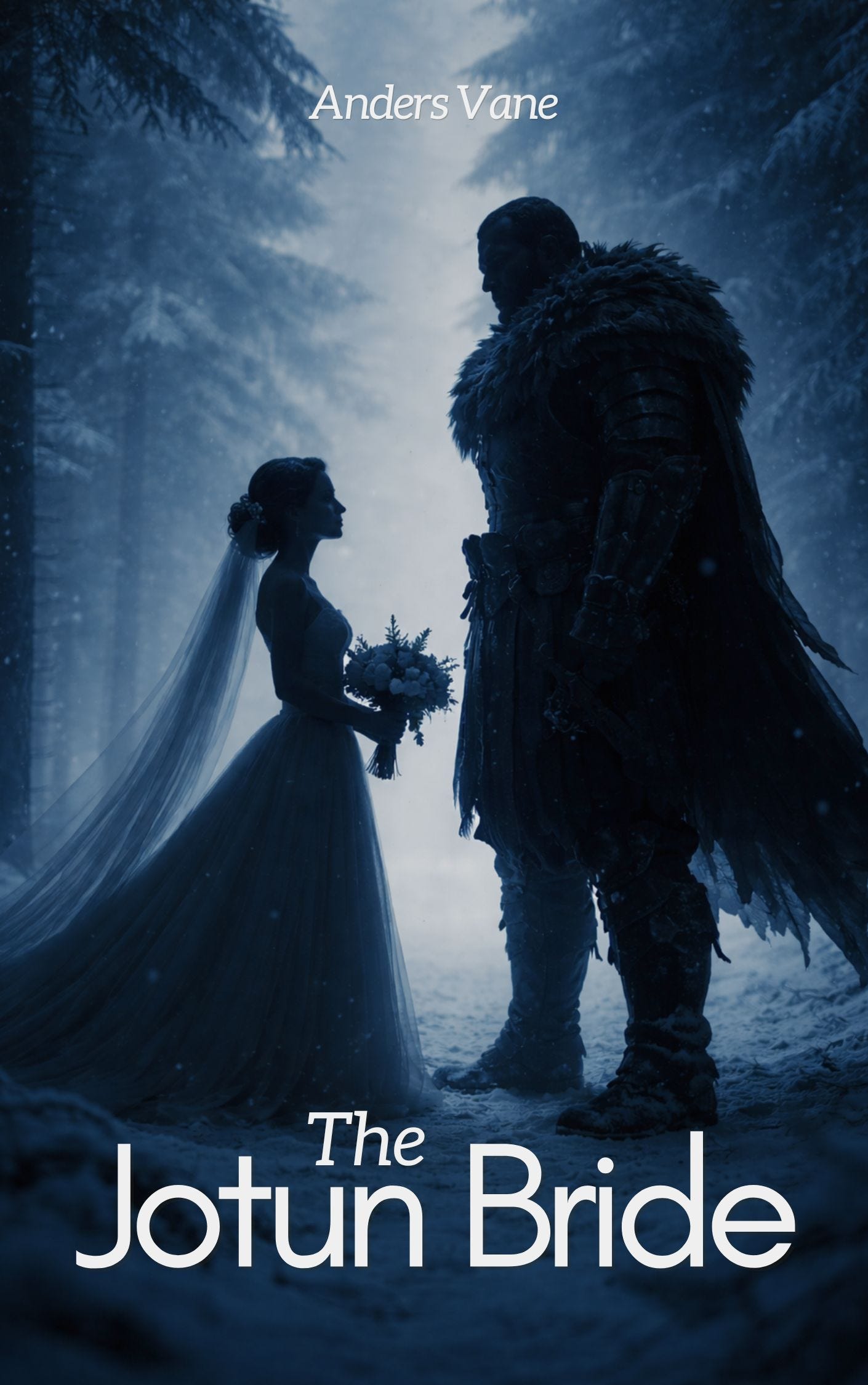
Well you told me I look Scandinavian, maybe I could blend in and enjoy some of the fish and play with the snow outside the longhouse? 🤭
"He portioned the fish with clean precision. The blade glinted. He slid the silvery belly onto her trencher."
So it's cold outside and they're eating fish? Can I join in? ☺️