


Chapter 1: The Bride
Winter pressed down on the longhouse until the timbers groaned like old bones. Wind knifed through the smoke-hole, swirling white dust across the rafters. The fire-pit heaved and spat, flames wrestling the storm for breath. Sparks flared, hissed, and vanished into the dark beams above.
Runa stood at the fire’s edge, back to the heat, watching the jarls gather. Cloaks wet with melting snow. Boots shedding slush across the reed mats. Voices scraping against each other like stone on stone. From outside, the breath of the entire square pressed against the door-seam, as if the city itself strained to see.
At the high seat, Hallvard Jarl leaned forward, shoulders hunched as if he carried more weight than his cloak. Gray threaded his beard. He had not looked at her since she entered. Emissaries and jarls from the other cities had planted themselves around him, each bearing the stink of worry.
Runa’s gaze climbed the rafters. The carved gods were gone, their hollow faces stripped from the eaves; the roof left naked above them. No eyes to witness oaths. No presence to warn against lies.
The old gods were not merely absent.
They had been torn out.
She recalled the stories—told to children to keep them small and obedient. Ice and mountain standing together, keeping frost-born horrors beyond the rift. That seam had burst long before she was born. Giants came down in a single winter and built their hall in the wound they carved. Men’s halls burned. Shrines were ripped from their beams. Whatever prayers lingered froze on their lips.
Varngard lived closest to that scar.
It had grown large not from strength, but from enduring.
A hold fattened on fear.
Outside, the city’s heart throbbed: shuttered markets, granaries bound in runes, boats trapped under ice. The smell of desperation clinging to stone. Every ear in the square listened for the longhouse doors.
The jarls muttered as emissaries unfurled their maps. Black runes on pale hide. Borders drawn and redrawn. Grain tallied like blood spilled. Runa heard fragments of her father’s voice—grain, tribute, northern roads. All the polite words for surrender.
“Look,” one jarl murmured, chin cutting toward her, “the bride.”
“Aye,” another breathed, sour with relief. “She’ll spare our walls another year.”
Runa let the words fall into her chest like coals.
“Better broken walls than bound hands,” she said.
A warrior shot her a warning look, but she did not lower her voice.
If the jarls wanted silence, they could carve it from her skull.
Then the doors tore inward.
The storm blasted into the hall, snuffing candles to smoke. Cloaks whipped. Men cursed. The fire staggered, shrinking back as if afraid of what crossed the threshold.
A shape entered—one that bent the lintel like wood under glacial creep.
Jögr.
Jarl of Kaldhall.
His skin was bleached bone, veins shot through with rime. Frost steamed from him in quiet, steady breaths. His wolf-skin cloak flared behind him, flinging shards of ice that spat against stone. Across his back: an axe of charred-black bone, its gouged carvings still echoing the claws that made them.
He was clean-shaven. The cold had polished his face to a blade’s sheen.
Height made him monstrous.
Presence made him worse.
His eyes swept the hall—pale hollows of winter-water, empty of warmth, full of appetite. Men sank against benches as those eyes brushed over them.
Then they reached her.
The gaze hit like frost finding a crack in granite, seeking the line that would split stone apart. Something in her breath caught. She strangled it before anyone heard.
Winter looked at her.
She did not bend.
She braced.
Behind him, three figures stepped through the storm’s mouth.
The first: a woman, towering even above Jögr, built like a smith’s dream of strength. White hair bound at her nape, black eyes simmering like coals trapped under ash. Her beauty was not gentle. It was forged. A warning.
The second moved with the hush of a stalking lynx. Long-limbed, taut, his gaze slicing rafters, beams, doorframes—measuring weaknesses. The bow across his back hummed with silence.
The third carried winter in her breath. Scarred throat, voice rasping like ice cracking. Pale eyes with no apologies in them. A long-hafted axe worn down to dull steel. A woman who had survived more cold than the walls around them.
They arranged themselves behind Jögr, not just as retinue but as omens.
More thundered outside: five hundred warriors, iron-sheathed and frost-marked, their wagons groaning under ore, meat, hide, tribute. The square was choking with giants, men, and something hungrier than either.
Hallvard rose.
“Jögr Jarl, of Kaldhall,” he said, each word dropping heavy, as if the hall itself might fracture under the weight.
“He comes to speak the terms of our bargain—and our binding.”
A murmur rolled through the benches—unease, resentment, resignation.
Arrangement.
Binding.
Chains shaped into syllables.
Runa already knew the terms. She’d been told the night before, in a voice hoarse with shame: she would be given. Her body as coin. Her womb as treaty. Her blood tying their hold to Kaldhall’s knife-edge mercy.
Jögr stepped forward.
Snow slithered from his cloak. The fire dimmed, cowed by the cold radiating off him; even the hall’s torches guttered as if their flames dared not flare too bright.
He carried silence like a blade.
And he pressed it into the hall until even breath became a cautious act.
He stopped before the high table.
Frost bled from him, crawling over the floor, racing up the legs of benches. Mead filmed over in brittle ice.
His gaze sought Runa again.
Held.
Weighed.
Measured.
The hall leaned, but she did not.
Her hand tightened on her hilt until her knuckles stung. She had stood before shield-walls, before men who wanted her dead, before nights that froze the blood in her veins. This—this gaze—should not have struck deeper than any of that.
But it did.
Not because she was afraid.
Fear she understood.
This was something else.
Hunger.
His eyes moved over her—hair, braids, scars, strength, softness—nothing lingering long, yet somehow he did not look away soon enough. When his gaze returned to hers, the air tightened, as if the hall itself waited to see which of them would break first.
Heat crawled under her skin.
He tilted his head a fraction.
Behind him, his captains began mapping with gestures—gate, bridge, granary, temple. Giants peeled toward the river gate. Others angled toward the square. Varngard already lay inside his reach.
The bargain was already sealed.
Her presence merely ink.
Runa met his gaze again—held it longer than she should have—until the fire crackled sharp between them and the cold crept across the stones like a sentience.
If he meant to take her, she would not wilt.
She would bare her teeth.
The Bargain
“You come in a hard season,” Hallvard said.
His voice was flint striking flint.
“All seasons are hard,” Jögr replied.
The sound rolled through the hall like stone dragged over ice. Runa felt it settle beneath her ribs, anchoring itself where breath should sit.
A jarl muttered about omens. Another spat into the fire, a pointless ward. The flames shuddered, shrinking back as though unwilling to warm what stood before them.
Jögr’s eyes stayed on Hallvard.
“This union strengthens both our kin,” he said. “We will endure.”
Sparks guttered low. Even the smoke seemed to bow.
Then he turned to Runa.
The hall thinned to a hum at the edge of hearing. Jarls, emissaries, her father—shadows. Only the line between her and Jögr remained.
She lifted her chin.
A blade’s angle.
A silent dare.
“Terms,” an emissary tried, his voice a brittle reed in the hush. “The war has gutted our clan. Bonds must be sealed.”
Hallvard spoke, each word pulled from the past like a splinter.
“An alliance to turn your spears south. Peace here. A band of your kin in Varngard every winter. And—”
The hall tightened.
Warriors who had held gates against storm and steel now dropped their eyes. Benches groaned under shifting weight. A silence with teeth gathered between them.
Hallvard’s jaw locked. His voice cracked like a frozen branch snapping.
“My daughter—”
“I am not a token.”
Runa’s words sliced clean through the hall. Unsoftened. Unapologetic.
Her father’s stare could have carved her to stone. But the silence that followed belonged to her alone.
Outside waited twenty wagons and the frost. The sum of peace.
Jögr’s mouth shifted. Not a smile. The shape of claim.
“Fierce,” he said.
The word carried the heat of possession and the cold of appraisal.
Hallvard lurched half to his feet. “You will listen, daughter—”
Jögr’s voice rolled over his, filling every beam and bone.
“No. Let her speak.”
Murmurs rippled—a startled sea—but Jögr did not look away from her.
“Speak then, shield-maiden. What think you of this bargain?”
Her pulse kicked hard. She let it.
“Peace bound in chains is already broken.”
“You would have war?”
“Better my people be free.”
“Then do not bare your throat in defiance.”
His gaze deepened—not warmer, only narrower, darker. “Unless you would have me to take it.”
Something sharp trembled through the hall. A note of danger, thin as cracked ice.
Slowly, he set his palm to the table. The wood groaned. Frost laced outward from his fingers, webbing across the grain. Even the candle flames leaned away.
“The men of Varngard will be free,” he said.
“And protected.”
His next words were iron dropped in snow.
“Because you are to wed me.”
The hall erupted.
Shouts broke like surf against rock. Men surged to their feet. A bench splintered under someone’s rage.
Steel rasped. Heat and cold collided in a chaos of breath and fury.
Hallvard’s fist slammed the arm of his chair.
“Enough!”
The word cracked through the din, the closest thing to thunder the hall remembered.
“It is done,” he said. “The vows are at dawn. Let our old gods witness.”
A cruel invocation.
The old gods had long since fled.
Jögr inclined his head—barely. If he feared or honored the broken gods, none could tell.
He stepped toward Runa.
His shadow fell across her, heavy as a winter sky pulled low.
He bowed. Tilted, immense, inevitable.
His breath brushed her cheek, warm against the cold promise in his eyes.
“You will learn what it means to belong,” he murmured.
The words were a binding dressed in velvet.
She tasted them—iron, cold, the faint burn of something forbidden.
Her hand locked on her knife-hilt until bone pressed through skin.
Anger rose. Clean, bright.
But beneath it—treacherous, coiled—something else stirred.
A flame. A pull. A recognition like sparks trying to catch.
His gaze moved over her again—quick, claiming nothing, promising everything.
She straightened until her spine sang. Then she drew her knife and set the blade to his throat.
“You mistake me, Jögr. I am not prey.”
Hallvard lurched half to his feet. A gasp tore through the hall—fear, disbelief, awe.
Jögr went very still.
Not threatened.
Interested.
A slow breath left him, cold enough to frost the steel. Then—unexpected, unsettling—he leaned into the knife. Let the point take his skin.
A bead of pale blood welled up. It froze almost at once.
Surprise flickered, then something darker. He laughed—low, quiet, the sound of ice cracking under weight.
“Good,” he murmured. “You think you have teeth.”
He tilted his head, letting her feel how easily he could have shattered her hand, her blade, her spine.
He did none of it.
“We shall see,” he said.
And he turned from her—unhurried, unbothered—as though granting her the last word had been his choice all along.
He strode out through the doors.
The instant he crossed the threshold, air rushed back into the hall. Candles flared. Men blinked like sleepers waking from a held breath.
Runa did not lower the blade.
She did not move at all.
“Take her,” Hallvard spat, not looking at her.
Two of his housecarls stepped forward, hands hovering near their hilts, unsure where to grab a woman who looked ready to bite. Runa didn’t wait for their touch. She slammed her knife back into its sheath—a sound that made the nearest guard flinch—and turned.
“I know the way to my own prison, father.” She walked through the parting crowd. No one touched her. They made a wide path, as if she were the one bringing the winter in.
Noise returned. Cups clinking, torches spitting, a servant murmuring about bedding for the bride.
And beneath it all, her pulse drummed, relentless.
Evening
“The feast is over,” Hallvard said. His voice had worn thin; there was nothing left in it to sharpen.
“Go to your bower, Runa. Prepare yourself.”
She looked at the empty space where Jögr had stood, at the guests slipping away, eyes skittering from her as if shame were catching.
“No.”
Hallvard blinked, as if the word itself were an insult. “What?”
“I will not crawl into the dark like some hidden mistress. If I am to be sold, let the buyer see what he’s bought.”
Better the glare of a hall than the closeness of four walls.
In the dark, there was no audience. Only the truth of her own fear.
She sat on the nearest bench, folded her arms, and stared into the fire.
Better here, where the room was wide and cold and full of other bodies—where no one could come close enough to touch what she couldn’t guard.
Hallvard’s jaw worked. Twice he lifted his hand as if to signal the guards. Twice he let it fall. In the end he only turned away.
One by one, the torches went out. She did not move.
As evening bled into night, the longhouse emptied. Embers pulsed low, stretching shadows long across the floor. Warriors collapsed into their furs in uneven heaps, breath rising and falling like distant surf.
Runa remained where she was—spine straight, jaw set. The fire died down to red coals, but she did not feed it.
She did not hear him enter. One breath she was alone. The next, the air breathed him—heat, weight, presence—before he appeared beside her, vast and silent, as though carved from the dark itself.
Her hand flew to the knife at her belt. His hand closed around her wrist before she cleared leather.
Cold. Immovable. A manacle made of winter.
She tore free. Fast—sharp as an unsheathed blade.
Jögr’s voice scraped low, like rock grinding beneath ice. “You are fierce even without eyes upon you.”
Her glare cut clean through the dim. “And you are exactly as obnoxious as I expected.”
Something shifted in his face. Not amusement—something more dangerous. A dark light, slow and deliberate, like hunger waking.
He leaned in, breath frost-edged against her cheek. “Then we will suit,” he murmured.
His gaze dropped—once—to her mouth. “Little shield-maiden.”
Heat roared through her, bright as fury, hot as shame, tangled and unwelcome. Her heart answered before her mind could silence it.
He did not leave. Instead, he shifted, settling onto the bench beside her. The wood groaned under the new weight. He stretched out, pulling his furs around him, claiming the space as if he had been born to it.
Runa stiffened. She could leave now. She could flee to the safety of her bower. But that would be retreat.
Slowly, deliberately, she lay back down on the hard wood, turning her back to him.
Outside, wolves howled—low, mournful—threading their voices through the rafters.
Runa lay beneath her cloak, eyes open. Sleep nowhere near.
She could have gone to her bower. Four walls, a door, a bed.
But walls made things loom closer.
And doors closed too quietly behind a man like Jögr.
Better the open hall.
Better bodies, breath, witnesses—
even if they slept.
The hall breathed around her: the rasp of snoring warriors, the hiss of embers, the slow pulse of winter pressing against the beams. But beneath it all, she felt him.
The shift of weight. The faint groan of wood as he moved closer.
She did not look.
For a long moment, he did not touch her. The restraint itself was a pressure, a heaviness in the air between their spines.
Then his hand slid beneath her cloak.
Not rough. Not claiming. Just presence—firm and certain—like a stone set in a river, altering its flow without effort. Heat flooded beneath his palm, swelling through her skin like something waking.
Her body locked tight as a drawn bow. She told herself to move. She did not.
His hand rose, slow as frost climbing a window, tracing the curve of her waist, the arch of her ribs, before stopping at her shoulder. Then, his thumb brushed the line of her throat.
It rested there—heavy, steady—on the pulse he could surely feel hammering like a trapped bird.
Her breath caught, traitorous. Her heart surged against that touch, wild and furious. Outside, wolves lifted their voices, long and rising, as if answering something they sensed in the hall.
She lay rigid, refusing him the flinch he seemed to wait for. She would not give him that victory.
But the truth crawled up her spine anyway: she did not move because she feared what it would mean to pull away, not what it would mean to stay.
When sleep finally pried her eyelids down, it was not the storm that followed her into the dark, but the weight of his hand. The thumb at her throat. The knowledge she would not name:
He had not forced.
She had stayed.
Dawn came like a wound reopening.
No feast. No song. Only a sparse gathering beneath the empty gaze of vanished gods. Altars cold. Firepits choked with ash. Once, oaths had lived here in blood and flame. Now they were scratched onto parchment and spoken with dry mouths.
Jögr recited the vows. Each syllable dropped like ice calving from a cliff—clean, heavy, final. Nothing in his voice suggested reverence. These were human words, brittle things.
Runa repeated them. The phrases scraped her throat raw. Each one settled around her like a new chain, but her voice did not shake.
“To the bond,” Hallvard said, his voice flat.
“To your dead gods,” Jögr answered.
Then he turned to her. The hall vanished from her sight; only the line between them remained. He looked at her not with triumph, but with the terrible certainty of a glacier that has already begun to move.
He offered his hand.
Runa stared at the palm that had rested on her throat in the dark. The heat of it still ghosted along her skin, a secret burned into her nerves.
She took it.
His fingers closed around hers—cool, hard, possessive.
To the men in the hall, they were wed.
To the jotuns, nothing was sealed.
Blood was the true bond. Iron the true witness.
That part still lay ahead.
She stood beside him anyway, feeling the shape of her future settle into her bones: not bride to a king, not shield-maiden of her people—
—but the woman bound to winter.
Not bride. Not consort.
Bonded to an avalanche already in motion.
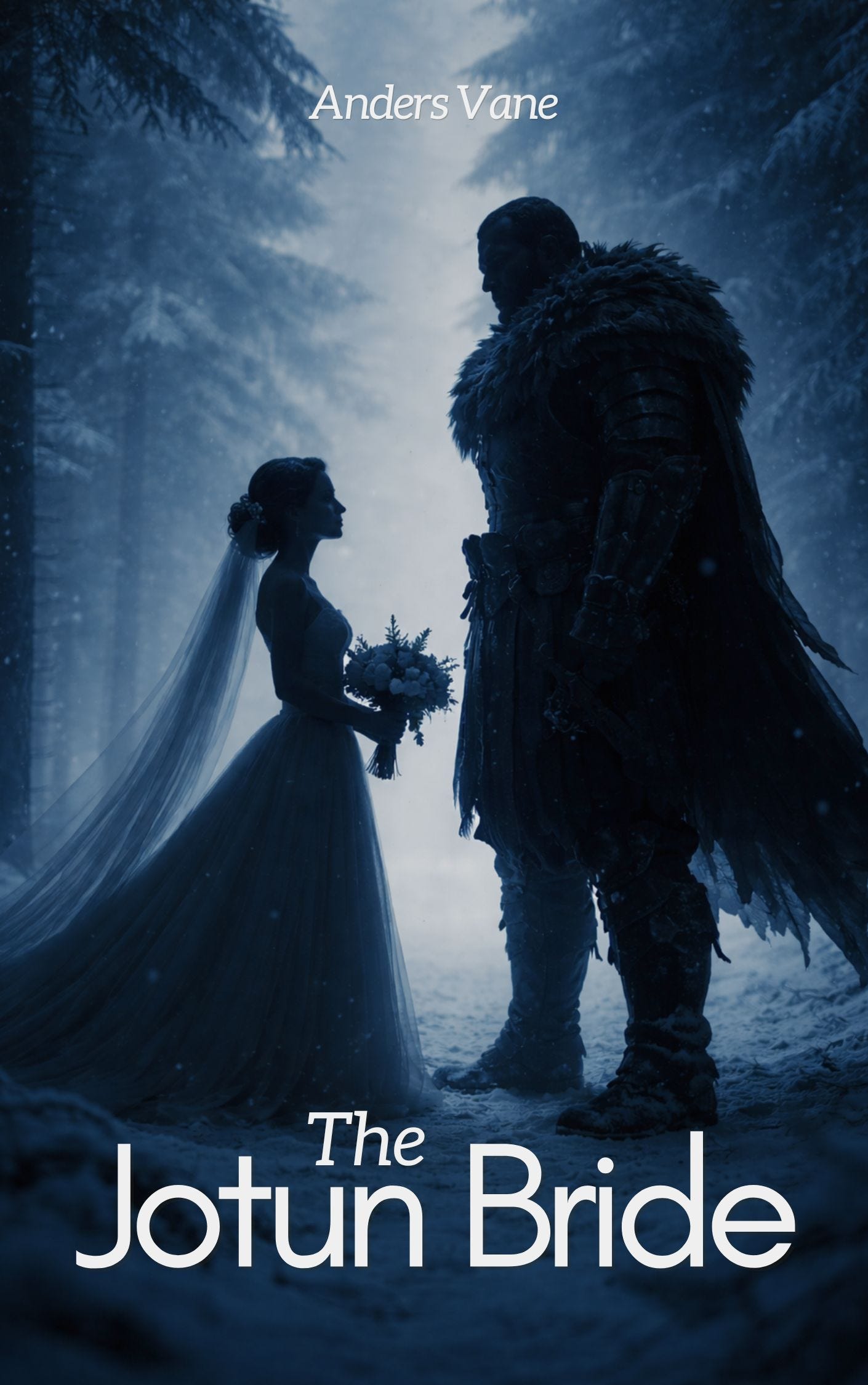
"When sleep finally pried her eyelids down, it was not the storm that followed her into the dark, but the weight of his hand. The thumb at her throat. The knowledge she would not name:
He had not forced.
She had stayed."
So did they sleep together the night before the wedding??