


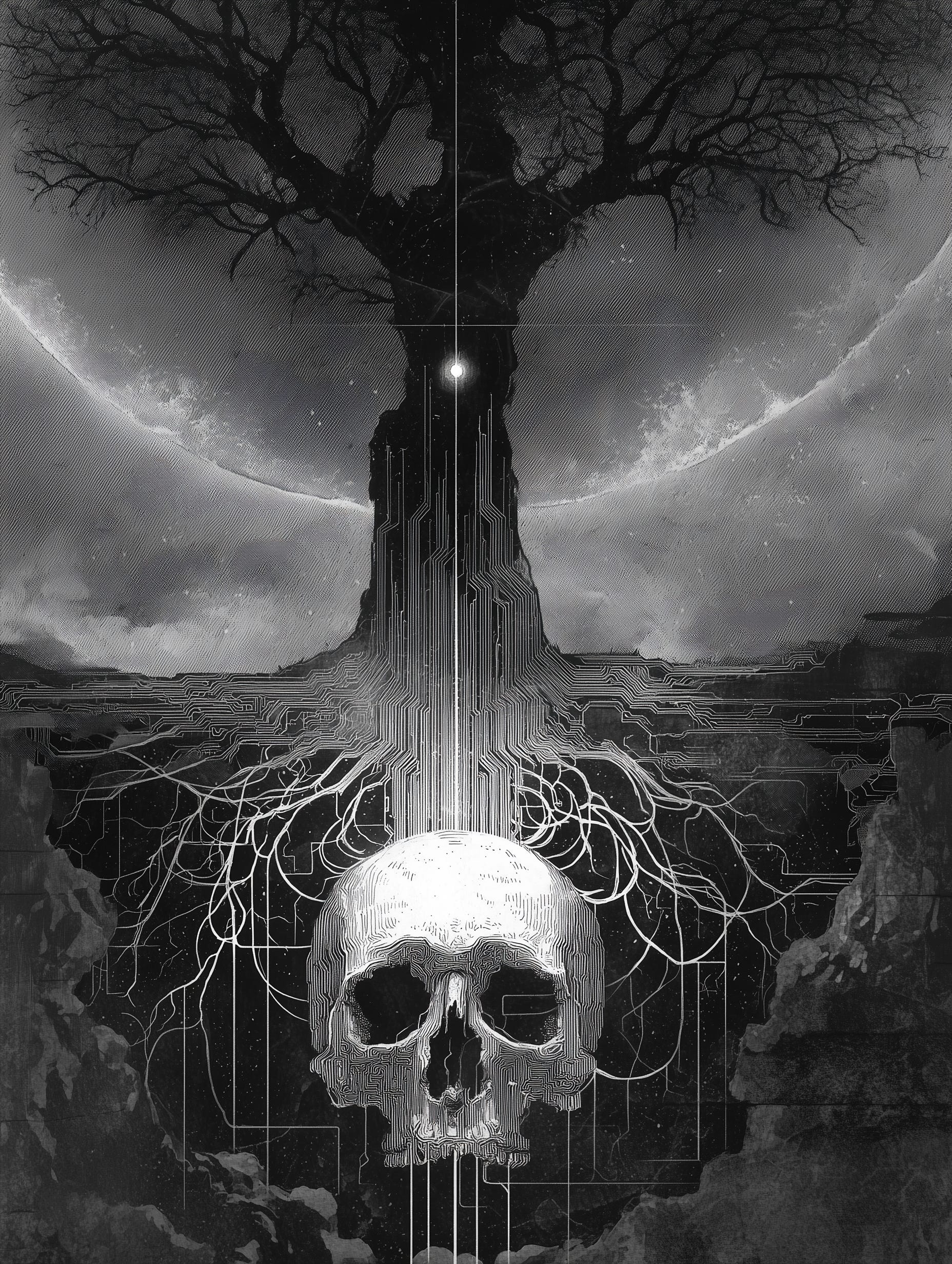
The standard Eddic story about Mímir goes like this: hostage swaps, offended Vanir, and a resurrected talking head.
This isn’t some ancient myth at all. It’s basically a medieval patch job Snorri applied to clean up contradictions he inherited. Strip away those political and theological stitches, and the “Iron Age Kernel” comes into view: Mímir isn’t a god who died, but a pre-temporal substrate1, a chthonic2 intelligence welded into the roots of the cosmos.
The “Head” isn’t a chopped-off body part; it’s a ritual interface. A skull-shaped oracle built to resonate with Deep Memory. Odin doesn’t receive wisdom as a gift; he trespasses into it. He rewires himself through sacrifice and self-mutilation, cracking his perception of reality permanently.
The Bureaucratic Overlay (The Lie)
Mímir shipped off as a hostage, beheaded for being “unhelpful,” sent back to Odin as a diplomatic tantrum is a classic medieval rationalization.
Snorri needed a political story to resolve a theological impossibility: Why does Odin possess access to something older, deeper, and more primordial than himself?
The hostage-myth solves the problem by:
Shrinking a chthonic power into a political actor.
Inventing a conflict that “transfers ownership.”
Reducing cosmic memory to a talking body part.
Reframing metaphysical transgression as bureaucratic fallout.
And directly contradicted by the older poetic material, where Mímir is alive, silent, intact, drinking mead each dawn at the root of the tree.
When the oldest sources disagree this sharply, it is not the myth that is wrong.
It is the editor.
The Snorri-version isn’t mythology. It’s damage control—tidy, moral, narratively convenient, and cosmologically false.
A Christian lawman’s attempt to make an alien cosmology safe, legible, and politically coherent.
For more insight into Snorri’s Edda lies, read here.
The Substrate: Mímir as Pre-Temporal Location
To reconstruct the myth, we must correct the category error.
Mímir is not an Aesir. Not a Vanir. Not a “person” in the divine family-tree sense.
He is a thurs.
In Norse cosmology, the thursar are not giants in the Marvel sense. They are conditions of existence: frost, fire, mountain, abyss, and the primordial logics beneath time.
Mímir’s domain is not the “past.” The past already implies chronology.
Mímir predates chronology.
He is the pre-temporal archive3. The deep root-substrate where causality, fate, and possibility pooled before time hardened into sequence.
His Well is not a container. It is the living root-memory of Yggdrasil, the layer where the world stores its earliest patterns, the proto-forms that preceded creation as we know it. He cannot be “sent” anywhere because he is not in the Well. He is the Well.
Speaking of “moving” him is like relocating magnetism with a cart.
Mímir is the cosmic condition in which memory is even possible.
The Uplink: The Sacrifice of the Eye
Odin isn’t meant to access this deep layer of memory. He belongs to the canopy. That is to say, the upper world—the realm of breath, language, and things that don’t last. The real tension in the myth isn’t about tribes at war, but about one realm invading another: the sky-world that must forget in order to keep moving, and the root-world that must remember in order to remain itself.
Odin does not receive access. He forces it, through violence committed upon himself.
Modern retellings sentimentalize the eye-sacrifice as “payment.” But the eye is not a coin. It is a sensory portal.
The light-eye sees the present.
The deep-eye sees what existed before the present was possible.
By gouging out his physical eye and sinking it into the Well, Odin rewires his perception: one eye faces the world, the other is swallowed by the Substrate. His consciousness becomes bi-located. He can no longer see anything except along its fracture-lines.
He does not become wise. He becomes incomplete.
From this moment on, he cannot look at the world; he looks through it. He sees only the fracture-lines where the future has already failed. This is why he becomes the prophet of Ragnarok: he is tethered to the layer where the ending is fossilized.
The sacrifice is not payment. It is installation—a neural graft into the world’s root-logic. And once installed, it cannot be undone.
The Interface: The “Head” as Ritual Technology
If Mímir is intact at the root, what is the “head” Odin carries? Not a decapitated counsellor. Not Vanir vandalism.
It is a ritual terminal.
A device tuned to the Substrate.
Across the Indo-European world, the skull was used for prophecy not because of superstition but because the skull is an anatomical resonance chamber: a cavity shaped by life to hold awareness, emptied to become a vessel for something older.
The “Head of Mímir” is not Mímir. It is tuned to Mímir.
A sanctified skull—human or giant—sustained through seiðr and held in a deliberate half-life to carry the signal. It acts as a transceiver tuned to the frequency of the Well. It does not transmit speech. Mímir does not speak. The Deep Memory communicates through:
Pressure.
Dread.
Sudden structure.
Intrusive knowledge.
Unignorable intuition.
The head does not advise. It distorts the user until they can receive the signal.
The Well is the Server.
The Skull is the Terminal.
The Eye is the Wired Connection.
This also raises a question Snorri’s version conveniently avoids: Whose skull was it originally? A king? A victim? A volunteer? A construct? The cultic logic offers no comfort, and the poem-tradition offers no answer.
What Odin carries is not a head. It is a bone-architecture optimized for metaphysical intrusion.
The Political Consequence: Odin as the Monopolizer of Fate
Once the interface exists, a new cosmic hierarchy emerges—one Snorri never understood and therefore never preserved.
Only Odin has mutilated himself to access the Substrate. Only Odin has a live uplink to the pre-temporal archive. Only Odin has a portable device capable of handling the signal.
This makes him the only being in the cosmos with fractured access to the structure of fate.
Tyr governs law.
Thor governs force.
Freyr governs prosperity.
Odin governs information.
His rule is not paternal. It is epistemological domination.
The other gods do not follow Odin out of affection or duty. They follow him because he alone has tunneled into the root-memory of the cosmos. His authority rests not on lineage, but on access — the single privilege every other power lacks. Without him, they are blind. With him, they are merely afraid.
Gods do not obey strength or lineage. They obey necessity. And Odin is the only necessity they have: the one mind with even the faintest access to the architecture of fate.
They are not a fellowship. They are a dependency network arranged around the single being who can see where the world is already splitting.
He becomes “Allfather” not because he fathers anything, but because he alone possesses the only connection worth ruling for. His power is not inherited; it is stolen. His authority is not legitimacy; it is privileged access to the memory-layer the others must pretend does not exist.
The Silence: What Mímir Withholds
Mímir’s silence is not absence. It is refusal.
He does not speak because the Substrate cannot speak; articulation would collapse it. Silence is the shape his knowledge is forced to take.
His silence is not a gap for Odin to fill; it is a boundary Odin cannot breach.
Odin can connect, but cannot command. He can query, but cannot rewrite. He receives fragments, never totality. The Well yields glimpses, not mastery.
What he gains is never what he sought.
And the glimpses come at the cost of self.
This refusal is why Odin never stops seeking: more runes, more prophecy, more mead, more necromancy, more forbidden modes of knowing.
The head grants access. Mímir denies clarity.
Odin has tapped into a layer of reality that does not want to be tapped, and the resistance is part of the transmission.
The Thief of Wisdom
This reconstruction restores what the medieval version hides: The myth is not about inheritance. It is about intrusion.
The Well is a memory older than the world. Mímir is the guardian-function of that memory. Odin is the being reckless enough to install part of himself inside it.
Iron Age ritual practice reflects the same truth: wisdom required deprivation, pain, sensory damage—knowledge as wound.
Odin’s foresight is fallout from a botched metaphysical trespass.
He plants an eye in the dark. He carries a skull that amplifies silence into shape. He siphons understanding from a being who remains intact, immovable, and utterly beyond him.
Mímir was never beheaded.
Because Mímir was never a man.
He is the deep archive of the cosmos, the memory before memory. Odin is the god who forced an unauthorized connection—and spends eternity losing pieces of himself to maintain the link.
What Odin calls wisdom is simply the part of himself the Well refuses to give back.
Odin does not possess wisdom.
He survives it.
Thanks for reading. Please subscribe and leave a comment below.
Substrate = the thing everything else rests on or grows out of. Like soil is a substrate for plants, or a circuit board is a substrate for electronics.
When I call Mímir a substrate I say he’s the deep architecture of reality. Odin approaching him is less “mentor–student” and more “hacker poking the oldest layer of the universe’s code.”
Chthonic = relating to the underworld, the deep earth, or primal forces that exist below the surface of the world.
When I say that Mímir is a chthonic intelligence, I’m saying: He’s not a old dude with a beard; he’s an ancient, subterranean consciousness integrated into the world’s foundations. An intelligence older than the gods, untouched by their politics, and humming with the kind of knowledge you don’t get without losing a piece of yourself.
Pre-temporal archive = a storehouse of information that existed before the world had chronology, events, or stories.
Mímir contains (or is) the deepest layer of cosmic memory. The gods don’t create him; they discover him. He holds knowledge that isn’t about the world. It’s the stuff the world is built from.
It’s like Odin is trying to read the BIOS of the universe, and Mímir is the machine it’s stored on.