


When Snorri Sturluson handed us the Eddas, he didn’t just preserve mythology.
He curated it.
And “curated” is the polite way of saying he edited, rearranged, sanitized, and fabricated connective tissue out of thin medieval air.
Bless him for writing anything at all. Without him, we would know almost nothing of the pre-Christian cosmos.
But let’s not pretend he was a neutral messenger from the Old Gods.
He was a Christian lawman explaining a dead religion to other Christian lawmen.
And that matters.
The older myths were not systematic.
They were not tidy.
They were not safe for Christian ears.
They were contradictory, dreamlike, violent, and profoundly alien.
So Snorri fixed them.
He did not record a mythology.
He rebuilt one.
And nowhere is that clearer than in the many major distortions he introduced — distortions that still shape every popular depiction of Norse mythology today.
Let’s go through the biggest ones.
But first: The Norse Scriptures
The Poetic Edda is the raw, original heartbeat, but these are fragmented and spotty. At best. You can read the first truly coherent overview of them in The Norse Scriptures—without the Snorri stench.
1. Historical Falsification: Turning Odin Into a Man From Asia
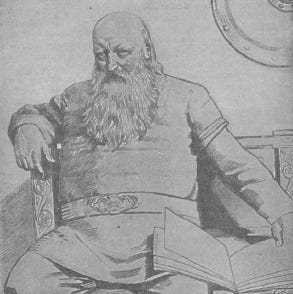
Snorri begins the Prose Edda with a stunning piece of theological damage control:
Odin wasn’t a god — he was a king from Asia.
This is Euhemerism: the strategy of turning gods into historical figures so the Church wouldn’t see you as a crypto-pagan.
Why it’s a lie
The Poetic Edda treats Odin as divine.
The skaldic tradition treats him as divine.
The place names treat him as divine.
Literally everything outside Snorri treats him as divine.
Snorri’s “Odin the immigrant king” is an alibi.
A way to write openly about pagan gods without being burned, stabbed, or politely disappeared.
This is the first crack in the illusion that Snorri was simply “recording” the myths.
2. Cosmological Systematization: The Nine Worlds That Never Were
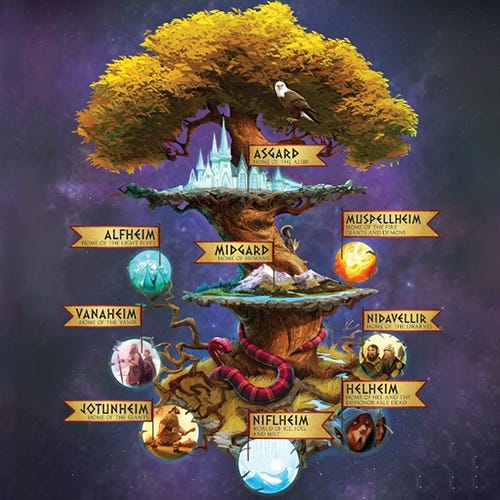
If you search for “Norse Mythology” today, you will find neat diagrams. It usually shows Yggdrasil as a vertical structure: Asgard on top (Heaven), Midgard in the middle (Earth), and Hel at the bottom (Hell), with bridges and roots connecting everything like a subway map.
Sometimes you’ll see a “Christmas Tree” model, where the worlds are hanging neatly on the trees branches.
This iconography is a Snorri invention.
The lies baked into it
Lie 1: The “Nine Worlds” were places
The poems mention “níu heimar” (nine worlds) exactly once, and never list them.
Most scholars now suspect “nine” meant all existence, not nine nations with border control.
Snorri turned a poetic abstraction into geography.
Lie 2: The vertical universe
In the Poetic Edda, the universe is horizontal, directional, and fluid.
Not a moral elevator.
Snorri imported Christian cosmology and reinterpreted the Norse universe through Heaven–Earth–Hell logic.
He built walls where the old worldview only had thresholds.
3. Moral Narrative Engineering: The Baldr Murder That Never Happened
(Not Like Snorri Says Anyway)
Here’s where Snorri’s fingerprints become obvious.
In Snorri’s version:
Loki crafts the mistletoe
Loki hands it to Hodr
Loki guides Hodrs hand
Loki commits premeditated murder
Snorri makes Loki the absolute architect of evil. He’s the Norse Devil.
It is a tight, clean, morally symmetrical tale. The kind medieval Christians adore.
But the poems?
They are messy.
Hodr shoots.
The mistletoe grows into a “harmful shaft.”
Loki is involved, somehow, but not in Snorri’s stage-managed way.
No hand-guiding.
No devil logic.
It feels more like fate erupting than a homicide plot.
The Smoking Gun: The Punishment
Even in the older poems, Loki is punished with a terrifying, disproportionate brutality. He is bound with the guts of his own son, with venom dripping onto his face for eternity.
If the older myth simply saw Baldr’s death as a tragic accident, why such a psychotic level of eternal punishment for Loki?
This is the hole Snorri had to fill. The punishment in the ancient sources was so extreme that it demanded an equally extreme crime.
Ancient Source: Hodr shoots Baldr. Loki is later found responsible and faces ultimate torment. The cause/effect is weak.
Snorri’s Fix: Loki must not only be the killer, but the mastermind. By inserting the detail that Loki “guided the hand,” Snorri provided a motivation commensurate with the agonizing punishment. He retrofitted the crime to match the established sentence.
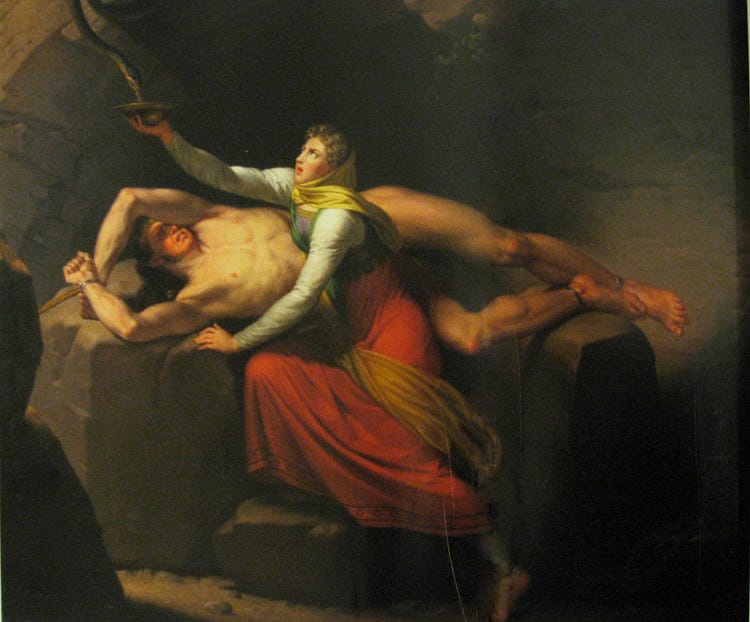
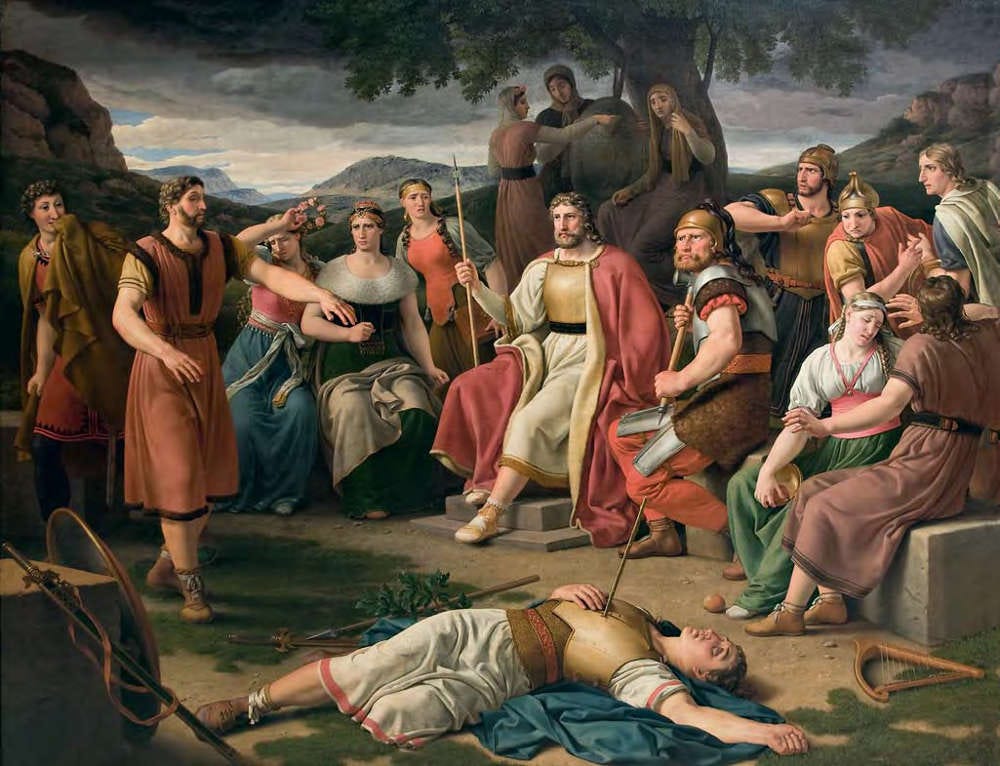
The psychotic punishment administered to Loki in ‘The Punishment of Loki’ (Christoffer Wilhelm Eckersberg, 1810)
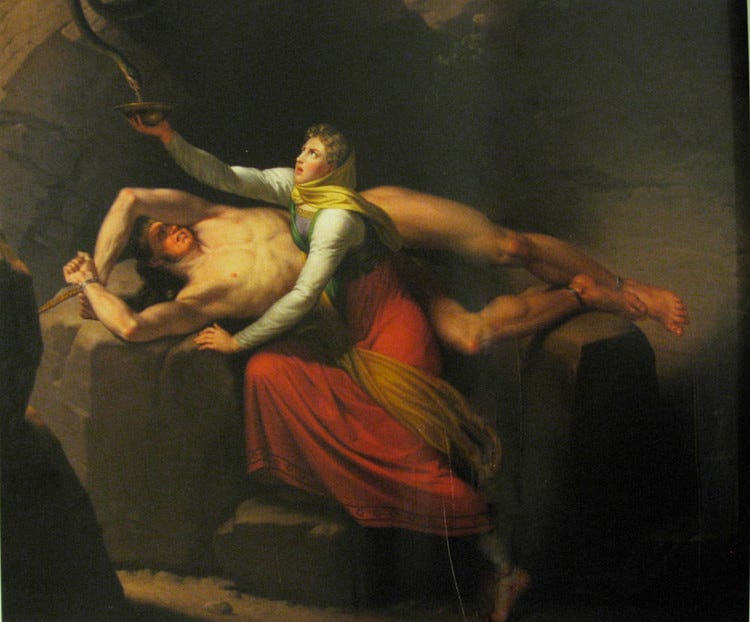
The result: Snorri transforms Loki from an impulsive, trickster figure (an agent of chaos, yes, but also necessary for the Gods’ survival) into an archetype of pure, intentional evil. He gave the gods a justifiable reason to torture one of their own so horribly, making the narrative morally satisfying for a medieval Christian audience obsessed with sin and eternal damnation.
4. Theological Importation: The Light Elves, Dark Elves, and the Invented Heavens
The first lie
Snorri creates a sharp, dualistic distinction that exists almost nowhere else in the arch-heathen record. He claims there are Ljósálfar (Light Elves) who are “fairer than the sun to look at” and live in a heaven called Víðbláinn, and Dökkálfar (Dark Elves) who are “blacker than pitch” and live underground.
Why it’s a lie: This is Christian theology dressed up in norse cosplay. Snorri needed angels and demons.
The older poems (like Völuspá or Grímnismál) barely make a distinction; elves and dwarves are often mentioned in the same breath as chthonic (earthly) spirits.
The idea of “Light Elves” living in a “Heaven” above the clouds is Snorri trying to fit Norse spiritualism into a Catholic worldview. He couldn’t accept moral ambiguity, so he bleached the elves to make them look like the heavenly host.
The second lie
Snorri claims that high above Asgard, there are two more heavens:
Andlang (”The End-Long” or “Extended”)
Víðbláinn (”The Wide-Blue”)
This is medieval Christian cosmology.
The “Layered Cake” Universe: The idea of stacked heavens (First, Second, Third Heaven) appears nowhere in the Poetic Edda. It is, however, standard Christian theology (St. Paul mentions the “Third Heaven” in 2 Corinthians).
The Linguistic Trick: Víðbláinn (Wide-Blue) and Andlang were simply just poetic synonyms for “the sky” in skaldic poetry. Snorri took adjectives describing the sky and turned them into symbols that has no place in the norse mythology.
The “Safe House” Problem: The terror of Ragnarok in the Poetic Edda is that no one is safe. The gods die. The earth sinks. The sun turns black. By inventing Víðbláinn as a “bunker” where the Good Light Elves can survive, Snorri ruins the stakes. He introduces the Christian promise of “Salvation for the Righteous” into a pagan myth about total cosmic collapse.
This is how I suspect Snorri’s thought process was like:
If Light Elves are angels, they need a Heaven…
Asgard is doomed to burn…
Invent a “Third Heaven” (Víðbláinn) above the fire, where the “Angels” can stay safe!
It is the theological equivalent of a plot armor.
If Snorri’s first lies distort the structure of the cosmos, the last four distort the nature of its inhabitants. He turns characters into moral symbols, stories into ethics lessons, and mythic dissolution into Christian eschatology.
5. Moralized Fate: The Lie of the Norns
Snorri’s Manufactured Trinity
This is a lie so fundamental that most people have forgotten it’s a lie.
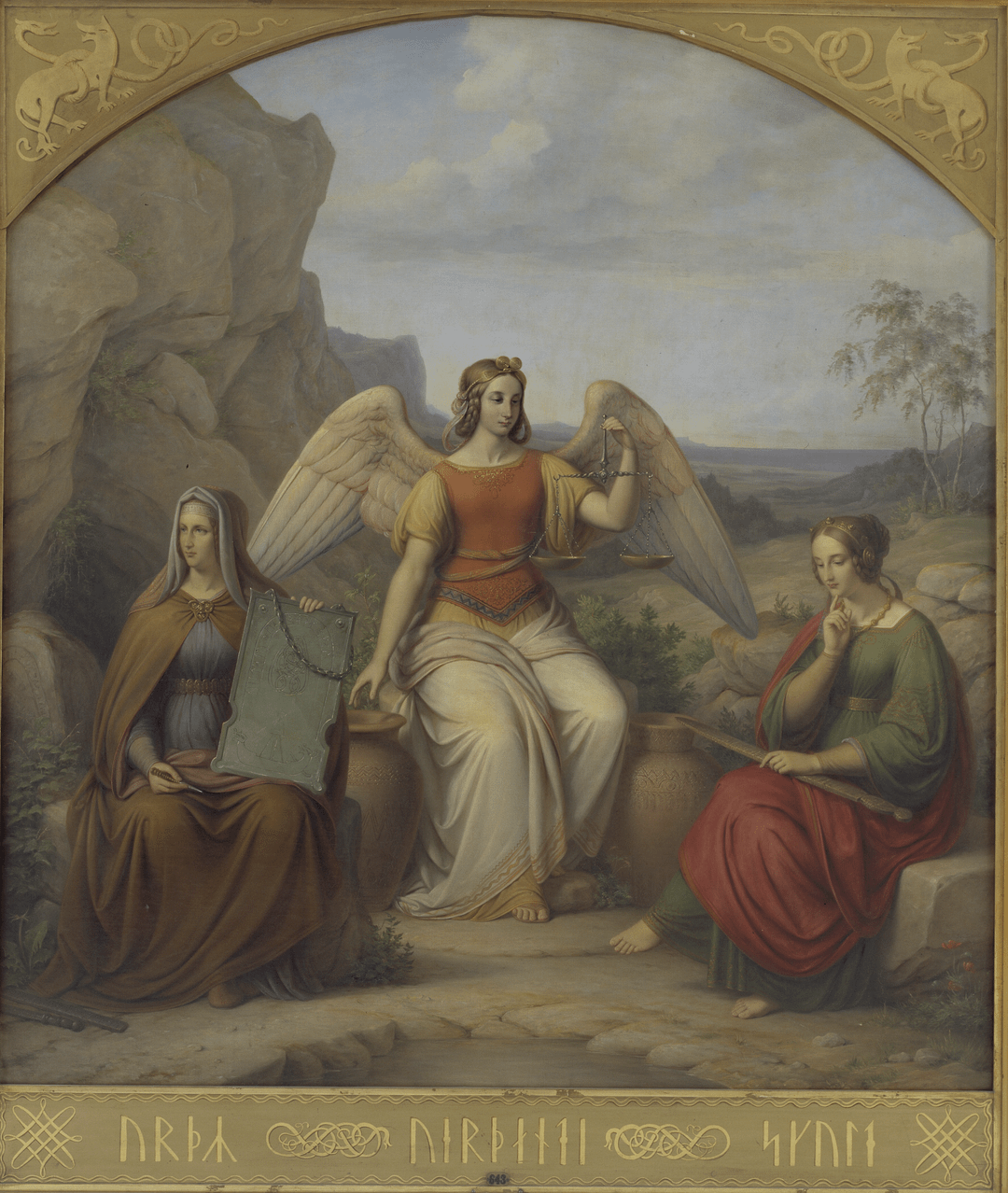
Modern readers imagine the Norns as three serene Fate-grandmothers, like a Norse knockoff of the Greek Moirai.
That image is a Snorri special.
The Lie
That fate is controlled by a stable, harmonious council of three women (Urd, Verdandi, Skuld), each with a clean job description.
The Reality
The Poetic Edda is explicit:
there are many Norns.
Some are good, some hostile, some tied to bloodlines, some tied to calamities.
They are not a board committee.
They are a species.
They appear at birth, at doom, at chaos — often without warning and with no moral logic. Fate in the poems is volatile and impersonal, not administrated by three cosmic librarians.
Snorri’s Intervention
He collapses the chaotic plurality into a neat Christian-friendly triad, complete with structured roles:
Urd (Past)
Verdandi (Present)
Skuld (Future)
This Past–Present–Future model did not exist before Snorri.
It is a medieval philosophical overlay.
He didn’t record the Norns.
He domesticated them.
This lie is so total that modern readers assume the triad is ancient, when it’s actually Snorri’s way of turning ungovernable destiny into something you can diagram.
We can discard these three completely.
6. Moral Afterlife: The Lie of Hel
The Underworld as Hell
Most modern depictions treat Hel as the Norse equivalent of Hell — a cold, punitive underworld for the unfortunate or unrighteous.
That entire concept is Snorri wearing a bishop’s hat.
The Lie
That Hel was a moral destination — a place of punishment for the “bad dead.”
The Reality
In the Poetic Edda and earlier layers:
Hel is neutral
Hel is inevitable
Hel is where most people go
Infants, elderly, sickness-deaths, peaceful deaths — all go to Hel.
Not because they sinned.
Because they died normally.
There is no moral judgment.
No torment.
No cosmic sorting mechanism.
Sometimes “Hel” is just a poetic word for “death” itself.
Snorri’s Distortion
Snorri reconstructs Hel as:
dark
subterranean
punitive
hierarchical
He gives the goddess Hel a demonic appearance and imports the vertical moral logic of Christianity:
Up = good. Down = bad.
He turned a neutral afterlife into a spiritual courtroom.
The result? A Christian underworld wearing a Norse name.
7. The Satan figure: The Lie of Loki
Snorri’s Moral Universe That Never Existed
The lie of Ragnarok and the lie of Loki feed each other.
Snorri needed a clear villain for his apocalypse, and he needed an apocalypse that justified having a villain.
The Lie of Loki as the Norse Devil
In the older poems, Loki is:
a problem-solver
a problem-creator
a shapeshifter
a necessary chaos agent
He is dangerous, amoral, brilliant and unpredictable, but never the embodiment of cosmic evil.
Loki’s real craft is this: he creates need where none existed, makes the gods dependent on his cunning, and turns himself into something they cannot function without. And he does all this without ever holding a throne or a title.
Snorri recasts Loki by giving him: coherent malice, clear motives, moral alignment and a place in a good-vs-evil war.
He retrofits Loki into an antagonist because his version of Ragnarok needs one.
This isn’t tradition.
This is theology wearing folklore as a mask.
8. Christian End Times: The Lie of Ragnarok as a Linear, Moral Apocalypse
Snorri turns Ragnarok into a structured end-times drama:
a cosmic battle with clean factions, predictable sequencing, poetic justice, and a redeemed New Earth for the worthy.
The Lie
That Ragnarok was a story with:
narrative order
moral symmetry
individual boss fights
a new world reserved for the righteous
The Reality
The Poetic Edda presents Ragnarok as:
fragmented
disordered
terrifying
fate-driven
morally ambiguous
It is not a final showdown between Good and Evil.
It is the collapse of the world’s supporting structures.
A convulsion of time itself.
Snorri adds:
one-on-one cinematic deaths
a strict timeline
a reborn paradise for survivors
clear hero/villain roles
Loki as a Satan analog
cosmic judgment patterns
He takes a mythic dissolution and turns it into a medieval Christian apocalypse.
Snorri didn’t show us Ragnarok.
He staged it.
So What Is the Truth?
The truth is not the neat, illustrated cosmology most people know today.
The truth is older, stranger, darker.
It lives in Hávamál, Völuspá, Vafþrúðnismál, Grímnismál, Baldrs draumar, Fáfnismál—those jagged, contradictory, atomized poems that Snorri tried to tame.
They are unreliable, fragmented, and occasionally incomprehensible.
But they are pre-Christian.
They do not care what you believe.
Snorri cared deeply.
And that is why the Poetic layer is “truer” in the mythological sense.
Why This Matters
Because almost every modern depiction of Norse mythology—Marvel, textbooks, YouTube explainers, even academic overviews—is based on Snorri’s curated version.
We inherited:
his map
his moral system
his cosmology
his version of Baldr
his angels
his architecture
We mistake a 13th-century Christian lawman’s creative rewrite for the religion of an Iron Age North.
It’s time to scrape his fingerprints off.
The Real Norse Mythology Is What Remains When Snorri’s Storytelling Stops Working
This is the principle behind my long-term project, The Norse Scriptures:
to reconstruct the mythic world as it appears in the pre-Snorri layer — the poems, fragments, riddles, and archaic logic he tried so hard to domesticate.
It’s also the foundation of several of my other books.
The goal is not to destroy Snorri. Quite the contrary, we are all immensely grateful for what he did. Many cultures deserved a Snorri.
The goal is simply to recognize what he built and what he borrowed.
Because the mythology he gave us is beautifully written…
…but it is not the one the ancestors believed in.
The real mythology is the one that survives when you remove the Christian scaffolding.
That’s where the true strangeness begins.
I really enjoyed this and I admire the fact that you want to shed light on the unadulterated essence of Norse mythology. 💯