


A story by Franz Kafka
I present this short story by Kafka on my blog because it’s a story to deserves to be read and understood by a wider audience. This new English translation is followed by a new Norwegian translation below.
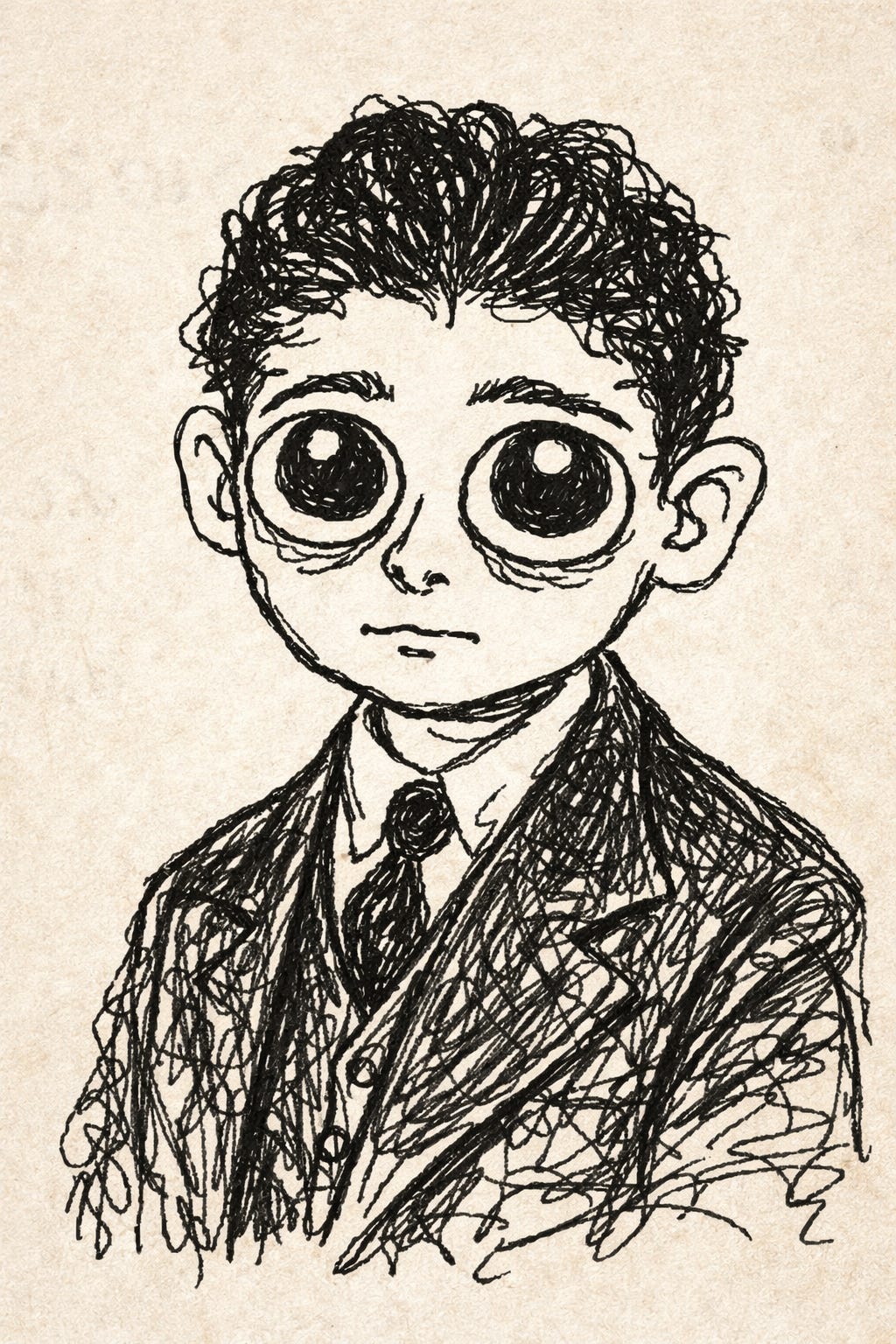
Franz Kafka (1883–1924) was a German-speaking Jewish writer from Prague whose stories turn everyday life into something quietly terrifying. His characters are trapped inside systems they can’t quite grasp, much less escape—bureaucracies, judgments, traditions, family expectations. The prose looks simple on the page, almost flat, but it carries a heavy philosophical charge underneath. Kafka published little while he was alive; much of what we now mean by “Kafkaesque” only appeared after his death.
"A Hunger Artist" ("Ein Hungerkünstler") is one of Franz Kafka’s most profound works, published shortly before his death in 1924.
In this story, Franz Kafka explores the thin line between spiritual discipline and total alienation. As the world moves on to more “visceral” entertainments, a man remains trapped in a cage of his own making, fasting for a glory that no longer exists. This new, hyper-precise translation by Anders Vane captures the clinical beauty and existential dread of Kafka’s original German prose.
The story is bleak, but also grimly funny. It’s about art versus entertainment, about being recognized for the wrong reasons, about how a society will admire your suffering only as long as it stays amusing. And it ends with a very Kafkaesque turn: the great “mystery” at the center isn’t some lofty spiritual calling, but a painfully ordinary absence—mistaken for greatness because no one knew what else to call it.
A Hunger Artist
In recent decades the interest in hunger artists has declined markedly. Where once it was profitable to mount such great performances on one’s own, today it has become quite impossible. Those were different times. Then the entire city occupied itself with the hunger artist; with each day of fasting the public’s participation grew; everyone wished to see him at least once a day; in the later stages there were subscribers who sat for days on end before the little barred cage. The viewing even took place at night, heightened by torchlight for effect. On fine days the cage was carried out into the open air, and it was then especially to the children that the hunger artist was shown. While to adults he was often no more than a joke—something fashionable, in which they took part for appearance’ sake—the children watched in amazement, open-mouthed, holding one another by the hand for safety, as he sat there—pale, in black tights, his ribs stark, refusing even a chair—upon scattered straw. Sometimes he would nod politely, answering questions with a strained smile, or even extend an arm through the bars so that one could feel how thin he was; then, however, he would sink wholly into himself again, caring for no one—not even for the striking of the clock so important to him, the cage’s only piece of furniture—but merely staring ahead with eyes almost closed, and from time to time sipping from a tiny glass of water to moisten his lips.
Besides the changing spectators there were also permanent guards, chosen by the public—curiously enough, usually butchers—who, always three at a time, had the task of watching the hunger artist day and night, lest he should secretly take nourishment. This, however, was only a formality introduced to reassure the crowd, for those in the know were well aware that during the fasting period the hunger artist would never, under any circumstances—not even under duress—have eaten the smallest morsel; the honour of his art forbade it. To be sure, not every guard could comprehend this. Sometimes there were night watches who performed their duty very laxly, huddling in a far corner over cards with the obvious intention of granting the hunger artist a small refreshment which, in their opinion, he might produce from some hidden store. Nothing was more agonising to him than such guards: they made him melancholy; they made his fasting dreadfully difficult. At times he overcame his weakness and sang during their watch for as long as he could endure it, merely to show the people how unjustly they suspected him. But it helped little; they only marvelled then at his cleverness in being able to eat even while singing.
He much preferred those guards who sat close to the bars and, not content with the dim night-lighting of the hall, lit him with electric torches supplied by the impresario. The harsh light did not disturb him in the least; he could not sleep anyway, and he could always doze a little, under any light and at any hour, even in the overcrowded, noisy hall. He was quite willing to spend the whole night without sleep with such guards; he was ready to jest with them, to tell them stories from his life on the road, and then to listen to theirs in turn—all merely to keep them awake, and to be able to show them again and again that he had nothing edible in his cage and that he was fasting as none of them could. He was happiest, however, when morning came and an ample breakfast was brought to them at his expense, upon which they fell with the appetite of healthy men after a gruelling night’s watch. There were even people who wished to see in this breakfast an improper influence upon the guards; but that went too far. And when such people were asked whether they themselves would be willing to take over the night watch without breakfast for the sake of the cause, they slunk away—yet clung to their suspicions nonetheless.
Such suspicions, however, were inseparable from fasting itself. No one, after all, was capable of remaining with the hunger artist as guard all those days and nights without interruption; thus no one could know from his own observation whether the fasting had truly been continuous and flawless. Only the hunger artist himself could know that; therefore he alone was the only spectator who could be fully satisfied by his fasting. Yet for another reason he was never satisfied. Perhaps he was not even so emaciated from fasting—though he was so thin that many, to their regret, had to stay away from the performances because they could not bear the sight of him—but rather he was so emaciated only out of dissatisfaction with himself. For he alone knew—and no other initiate knew it—how easy fasting was. It was the easiest thing in the world. He did not keep this secret, yet people did not believe him; at best they thought him modest, but for the most part they considered him a self-promoter or even a fraud—for whom fasting was indeed easy because he knew how to make it easy for himself, and who even had the effrontery half to admit it. He had to accept all this, and over the years had grown used to it; but inwardly this dissatisfaction always gnawed at him, and never yet, after any period of fasting—this testimony must be given him—had he left the cage of his own accord.
The impresario had set forty days as the maximum fasting time; beyond that he never allowed the fasting to continue, not even in the great metropolises of the world, and for good reason. Experience showed that for about forty days one could increasingly whip up a city’s interest through gradually intensifying publicity; but after that the public failed, and a marked decline in patronage could be observed. Naturally there were small differences in this respect between cities and countries, but as a rule forty days was the maximum. Then, on the fortieth day, the door of the flower-garlanded cage was opened, an enthusiastic audience filled the amphitheatre, a military band played, two doctors entered the cage to make the necessary measurements on the hunger artist, the results were announced to the hall through a megaphone, and finally two young ladies came—happy that they of all people had been chosen by lot—and wished to lead the hunger artist out of the cage down a few steps, where a carefully selected invalid’s meal stood ready upon a small table.
And at this moment the hunger artist always resisted. To be sure, he still placed his bony arms into the helpfully outstretched hands of the ladies leaning down towards him, but he did not wish to stand up. Why stop now, after exactly forty days? He could have endured much longer, indefinitely longer. Why stop precisely now, when he was in his best—no, not yet in his best—fasting state? Why did they wish to rob him of the fame of fasting further, of becoming not only the greatest hunger artist of all time—which he probably already was—but of surpassing himself into the incomprehensible? For he felt no limits to his capacity for fasting. Why did this crowd, which pretended to admire him so greatly, have so little patience with him? If he could endure fasting further, why could they not endure watching? He was tired besides, sitting comfortably in the straw, and was now supposed to draw himself up high and tall and go to the food—the very thought of which made him nauseous, a nausea he suppressed only with difficulty out of consideration for the ladies. And he looked up into the eyes of the seemingly so friendly, but in truth so cruel, young women and shook his head, which was too heavy for his weak neck.
Then happened what always happened. The impresario came and silently—the music made speech impossible—raised his arms over the hunger artist, as if inviting Heaven to look down upon its work here in the straw, upon this pitiable martyr, which the hunger artist indeed was, though in a quite different sense. He seized the hunger artist about his thin waist—seeking thereby, through exaggerated caution, to make credible what a fragile thing he was handling—and handed him over (not without giving him a little secret shake, so that the hunger artist’s legs and upper body swayed uncontrollably to and fro) to the ladies, who had meanwhile turned deathly pale. Now the hunger artist endured everything. His head lay upon his chest as though it had rolled there and inexplicably remained; his body was hollowed out; his legs, in an instinct of self-preservation, pressed together at the knees, yet scraped the floor as if it were not the real one, as if they were searching for the real one; and the whole, admittedly very small, weight of his body rested upon one of the ladies, who, seeking help and panting—for she had not imagined this honorary office quite like this—stretched her neck as far away as possible in order at least to protect her face from contact with the hunger artist; but then, since she did not succeed and her luckier companion did not come to her aid, contenting herself with tremblingly carrying before her the hunger artist’s hand, this little bundle of bones, she burst into tears amid the delighted laughter of the hall and had to be relieved by an attendant who had long been standing ready. Then came the food, of which the impresario forced a little into the hunger artist during a faint-like half-sleep, amid cheerful chatter meant to distract attention from his condition. Then a toast was even offered to the public—allegedly whispered to the impresario by the hunger artist—and the orchestra confirmed everything with a grand fanfare. The crowd dispersed, and no one had the right to be dissatisfied with what he had seen—no one, only the hunger artist, always only he.
Thus he lived for many years, with regular short pauses, in apparent splendour, honoured by the world, and yet for the most part in a dismal mood, which grew still more dismal because no one understood how to take him seriously. With what should one comfort him? What remained for him to wish for? And if ever a good-natured soul was found who pitied him and wished to explain to him that his sadness probably came from fasting, it could happen—especially at an advanced stage of fasting—that the hunger artist answered with an outburst of rage and, to everyone’s terror, began to shake the bars like an animal.
For such states the impresario had a punitive measure he liked to employ. He would apologise to the assembled public for the hunger artist, admitting that only the irritability caused by fasting—which well-fed people could not readily understand—made his behaviour excusable. In this connection he would also mention the hunger artist’s claim—likewise to be explained—that he could fast much longer than he did. He praised the lofty striving, the good will, the great self-denial surely contained in this claim; but then he sought to refute it simply enough by showing photographs, which were sold at the same time—for in the pictures one saw the hunger artist on the fortieth day of fasting, in bed, almost extinguished by exhaustion. This distortion of the truth, well known to the hunger artist yet always unnerving him anew, was too much for him. What was the consequence of the premature termination was presented here as its cause! To fight against this lack of understanding, against this world of misunderstanding, was impossible. He would still listen in good faith, eager at the bars, to the impresario; but at the appearance of the photographs he would always let go of the bars, sink back with a sigh into the straw, and the reassured public could come closer again and view him.
When the witnesses of such scenes looked back on them a few years later, they often became incomprehensible even to themselves. For meanwhile the turning point already mentioned had occurred; it had happened almost suddenly; there may have been deeper reasons for it, but who cared to seek them? In any case, one day the pampered hunger artist saw himself abandoned by the pleasure-seeking crowd, which preferred to flock to other spectacles. Once more the impresario travelled through half of Europe with him to see whether the old interest might not be found again here or there; all in vain. As if by secret agreement, a positive aversion to public fasting had developed everywhere. Of course, in reality this could not have happened so suddenly, and people now, retrospectively, remembered many omens that had not been sufficiently heeded—or had been suppressed in the intoxication of success; but to do anything about it now was too late. It was, to be sure, certain that the time for fasting would come again—but for the living that was no comfort. What was the hunger artist to do now? He whom thousands had cheered could not show himself in booths at small fairs, and to take up another profession he was not only too old for, but above all too fanatically devoted to fasting. So he dismissed the impresario, the companion of an unparalleled career, and quickly had himself engaged by a large circus; to spare his sensibilities he did not even look at the terms of the contract.
A large circus, with its multitude of people, animals, and apparatus constantly balancing and supplementing one another, can use anyone at any time—even a hunger artist—provided his demands are modest enough, of course. Moreover, in this particular case it was not merely the hunger artist himself who was engaged, but also his old, famous name. Indeed, given the peculiar nature of this art, which did not diminish with increasing age, one could not even say that a superannuated artist, no longer at the height of his powers, wished to withdraw into a quiet circus post. On the contrary, the hunger artist insisted—quite credibly—that he fasted just as well as ever; he even claimed that if he were allowed his way—and this was promised him without further ado—he would only now truly amaze the world, a claim which, however—considering the spirit of the times, which in his zeal he easily forgot—evoked nothing but a smile among the experts.
Fundamentally, however, the hunger artist did not lose sight of the actual circumstances and took it as a matter of course that his cage would not be placed as a star attraction in the middle of the arena, but would be set up outside in a spot that was otherwise quite accessible, near the stables. Large, brightly painted signs framed the cage and announced what was to be seen there. When the public, during the intervals of the performance, surged toward the stables to view the animals, it was almost inevitable that they should pass the hunger artist and stop there a moment. One might perhaps have stayed with him longer had it not been for the pressure of those behind in the narrow passage—who did not understand this delay on the way to the longed-for stables—which made any longer, quiet observation impossible.
This was also the reason why the hunger artist, before these visiting hours—which he naturally longed for as the purpose of his life—nevertheless trembled. In the early days he could hardly wait for the intervals; he looked forward with delight to the rolling mass of people, until he convinced himself all too soon—no self-deception, however stubborn and almost conscious, could withstand experience—that for the most part, according to their intention, time and again, without exception, they were merely visitors to the stables. This sight from a distance remained the most beautiful. For when they reached him, he was at once surrounded by the shouting and cursing of the continuously forming factions: those who—this soon became the more painful for him—wanted to look at him at their leisure, not out of understanding but out of whim and defiance; and a second group that demanded chiefly to get to the stables. Once the great crowd had passed, the stragglers came—those who, no longer hindered from standing still as long as they liked, nevertheless hurried past with long strides, almost without a side glance, to reach the animals in time.
And it was not too frequent a stroke of luck when a father came with his children, pointed to the hunger artist, explained in detail what this was all about, spoke of earlier years when he had attended similar—though incomparably more magnificent—performances, and then the children, owing to their insufficient preparation by school and life, remained without understanding—what was fasting to them?—and yet, in the glow of their searching eyes, betrayed something of new, coming, more merciful times. Perhaps, the hunger artist sometimes said to himself, everything would become a little better if his place were not quite so close to the stables. It made the choice too easy for the public, not to mention that the exhalations of the stables, the restlessness of the animals at night, the carrying past of raw pieces of meat for the predators, and the screams during feeding, offended and oppressed him unceasingly. Yet he did not dare to petition the management; after all, he owed the animals the crowd of visitors, among whom there might now and then be one meant for him—and who knew where he might be hidden away if he wished to remind them of his existence, and thus also of the fact that, strictly speaking, he was only an obstacle on the way to the stables.
A small obstacle, to be sure—one that steadily diminished. People grew accustomed to the eccentricity of claiming attention for a hunger artist in these modern times, and with this habituation the judgement upon him was pronounced. He might fast as well as he possibly could—and he did—but nothing could save him now; they passed him by. Try explaining the art of fasting! He who does not feel it cannot be made to understand it. The beautiful signs became dirty and illegible; they were torn down, and it occurred to no one to replace them. The little tablet with the number of days fasted, which in the early period had been carefully renewed daily, had long remained the same, for after the first few weeks the staff themselves had grown weary of this small task. And so the hunger artist fasted on, just as he had once dreamed, and he succeeded without effort just as he had predicted; but no one counted the days, no one—not even the hunger artist himself—knew how great the achievement already was, and his heart grew heavy. And when now and then a loiterer stopped, made fun of the old figure on the tablet, and spoke of a swindle, that was, in its own way, the stupidest lie that indifference and innate malice could invent; for it was not the hunger artist who cheated—he worked honestly—but the world cheated him of his reward.
Yet many days passed again, and that too came to an end. Once the eye of an overseer fell upon the cage, and he asked the attendants why they left this perfectly good cage standing here unused with the rotten straw inside. No one knew, until one of them, with the help of the numbered tablet, remembered the hunger artist. They stirred up the straw with poles and found him in it.
“Are you still fasting?” the overseer asked. “When will you finally stop?”
“Forgive me, all of you,” whispered the hunger artist; only the overseer, who put his ear to the bars, understood him.
“Certainly,” said the overseer, tapping his forehead to indicate the hunger artist’s condition to the staff. “We forgive you.”
“I always wanted you to admire my fasting,” said the hunger artist.
“We do admire it,” said the overseer obligingly.
“But you mustn’t admire it,” said the hunger artist.
“Then we don’t admire it,” said the overseer. “Why mustn’t we admire it?”
“Because I have to fast; I cannot do otherwise,” said the hunger artist.
“Just look at that,” said the overseer. “And why can’t you do otherwise?”
“Because I,” said the hunger artist, lifting his head a little and speaking with lips pursed as though for a kiss straight into the overseer’s ear so that nothing might be lost, “because I could not find the food I liked. Had I found it, believe me, I would have made no spectacle and would have eaten my fill like you and everyone else.”
Those were his last words, but in his broken eyes there still lay the firm conviction—no longer proud—that he was still fasting.
“Clear this away,” said the overseer, and they buried the hunger artist together with the straw. But into the cage they put a young panther. It was a perceptible relief, even to the dullest sense, to see this wild animal leaping about in the cage that had been desolate so long. He wanted for nothing. The food he liked was brought to him by the guards without much reflection; he did not even seem to miss freedom. This noble body, furnished with everything it needed almost to the point of bursting, seemed to carry freedom about with it; it seemed to be lodged somewhere in its jaws; and the joy of life came from its throat with such hot force that it was not easy for the spectators to endure. But they overcame themselves, crowded round the cage, and did not want to move away at all.

EN SULTEKUNSTNER
Fortelling av Franz Kafka
I de siste tiårene har interessen for sultekunstnere sunket betraktelig. Mens det før i tiden var svært lønnsomt å arrangere store forestillinger i egen regi, er dette i dag fullstendig umulig. Det var andre tider den gang. Da var hele byen opptatt av sultekunstneren; fra sultedag til sultedag steg deltakelsen; alle ville se ham minst én gang om dagen. Etter hvert fantes det faste abonnenter som satt i dagesvis foran det lille gitterburet; det ble også holdt visninger natterstid for å øke virkningen i fakkellyset. På fine dager ble buret båret ut i det fri, og da var det særlig barna som fikk se sultekunstneren; mens han for de voksne ofte bare var en kuriositet de overvar for motens skyld, så barna forundret og gapende på – for sikkerhets skyld holdt de hverandre i hendene – der han satt blek, i svart trikot, med voldsomt utstikkende ribbein, og til og med forsmådde en stol der han satt på utstrødd halm. Han nikket høflig, besvarte spørsmål med et anstrengt smil, og stakk også armen gjennom gitteret for at de skulle få kjenne hvor mager han var, før han igjen sank helt inn i seg selv og ikke brydde seg om noen – ikke engang om det for ham så viktige slagverket på uret, som var burets eneste møbel – men bare stirret foran seg med nesten lukkede øyne og fuktet leppene med en sjelden slurk fra et ørlite glass vann.
Foruten de skiftende tilskuerne var det også faste vakter til stede, valgt av publikum, merkelig nok vanligvis slaktere, som – alltid tre samtidig – hadde i oppgave å overvåke sultekunstneren dag og natt, slik at han ikke på lønndom skulle ta til seg næring. Dette var imidlertid bare en formalitet, innført for å berolige massene, for de innviede visste utmerket godt at sultekunstneren i sultetiden aldri, under noen omstendigheter, selv ikke under tvang, ville ha spist det minste grann; hans kunstneriske ære forbød det. Riktignok fantes det vakter som ikke begrep dette; det hendte nattlagene utførte bevoktningen svært skjødesløst, satte seg med vilje sammen i et fjernt hjørne og fordypet seg i kortspill, i den åpenbare hensikt å unne sultekunstneren en liten forfriskning som de mente han kunne trylle frem fra et hemmelig lager. Ingenting var mer pinefullt for sultekunstneren enn slike vakter; de gjorde ham tungsindig og gjorde sultingen grusomt tung; av og til overvant han svakheten sin og sang under disse vaktene så lenge han maktet, for å vise folk hvor urettmessig de mistenkte ham. Men det hjalp lite; de bare undret seg over ferdigheten hans i å spise selv mens han sang. Langt bedre likte han vaktene som satte seg tett inntil gitteret og lyste på ham med de elektriske lommelyktene som impresarioen hadde stilt til rådighet. Det skarpe lyset forstyrret ham ikke; sove kunne han uansett ikke, og å døse kunne han gjøre i enhver belysning og til enhver tid, selv i en støyende sal. Han var mer enn villig til å tilbringe hele natten våken med slike vakter; han spøkte med dem og fortalte historier fra sitt omflakkende liv, alt for å holde dem våkne og stadig kunne vise dem at han ikke hadde noe spiselig i buret og at han utøvde en sulting ingen av dem ville vært i stand til. Men lykkeligst var han når morgenen kom og det på hans regning ble brakt dem en overveldende frokost, som de kastet seg over med matlysten til friske menn etter en slitsom våkenatt. Det fantes riktignok folk som ville tolke denne frokosten som en utilbørlig påvirkning av vaktene, men det var å gå for langt; spurte man om de selv ville påta seg nattevakten uten frokost bare for sakens skyld, trakk de seg unna, selv om de holdt fast ved sine mistanker.
Denne skepsisen var imidlertid uadskillelig fra selve sultekunsten. Ingen var i stand til å overvåke sultekunstneren uavbrutt hver eneste time, følgelig kunne ingen av selvsyn vite om det virkelig var blitt sultet plettfritt; bare sultekunstneren selv kunne vite det, bare han kunne være den tilskueren som var fullkomment tilfredsstilt av sin egen prestasjon. Men han var på sin side aldri tilfreds, av en helt annen grunn; kanskje var han ikke engang så avmagret av selve sultingen at folk holdt seg unna fordi de ikke tålte synet, men han var snarere tært bort av misnøye med seg selv. Han alene visste nemlig hvor lett det var å sulte. Det var den letteste sak i verden. Han la ikke skjul på det heller, men man trodde ham ikke; man holdt ham i beste fall for beskjeden, men som oftest for oppmerksomhetssyk eller til og med for en svindler som forsto å gjøre sultingen lett for seg selv, og som i tillegg hadde frekkhetens nådegave til å innrømme det halvveis. Alt dette måtte han finne seg i, men innvendig gnagde denne utilfredsheten alltid i ham, og aldri hadde han etter en sultperiode forlatt buret frivillig.
Impresarioen hadde fastsatt førti dager som makstid; utover dette lot han ham aldri sulte, heller ikke i verdensmetropolene, og det med god grunn. Erfaringsmessig kunne man piske opp interessen i en by i førti dager med økende reklame, men så sviktet publikum; man kunne konstatere en vesentlig nedgang i besøkstallet. På den førtiende dagen ble døren til det blomsterkransede buret åpnet, en begeistret tilskuerskare fylte amfiteateret, et militærorkester spilte, to leger trådte inn i buret for å foreta de nødvendige målingene, og til slutt kom to unge damer, lykkelige over at nettopp de var blitt trukket ut, for å lede sultekunstneren de få trinnene ned fra buret, hvor et nøye utvalgt kurmåltid sto klart. Og i dette øyeblikket satte han seg alltid til motverge. Riktignok la han fremdeles frivillig sine beinkalde armer i de hjelpsomme hendene til damene som bøyde seg over ham, men han ville ikke reise seg. Hvorfor slutte akkurat nå? Han ville ha holdt ut ubegrenset lenge; hvorfor slutte nå, da han var i sin beste sulting? Hvorfor ville man berøve ham berømmelsen ved å sulte videre, å ikke bare bli den største sultekunstneren gjennom tidene, men også å overgå seg selv inn i det ufattelige? For han følte ingen grenser for sin evne til å sulte. Hvorfor hadde denne mengden, som ga seg ut for å beundre ham, så lite tålmodighet? Hvis han holdt ut å sulte lenger, hvorfor kunne ikke de holde ut å se på? Han var dessuten trett, satt godt i halmen og skulle nå reise seg og gå til maten, som bare i tankene forårsaket en kvalme han med nød og neppe undertrykte av hensyn til damene.
Og han så opp i øynene på de tilsynelatende så vennlige, men i virkeligheten så grusomme damene, og rystet på det tunge hodet på den svake halsen. Men så skjedde det som alltid skjedde. Impresarioen kom, løftet ordløst – musikken gjorde det umulig å tale – armene over sultekunstneren, som om han inviterte himmelen til å ta sitt verk i øyesyn, denne bedrøvelige martyren, som sultekunstneren sannelig var, bare i en helt annen forstand; han tok ham rundt den tynne midjen med overdreven forsiktighet for å understreke hvor skrøpelig han var, og overga ham – ikke uten å riste ham litt i all hemmelighet, slik at sultekunstneren svingte ukontrollert frem og tilbake – til damene, som i mellomtiden var blitt likbleke. Nå fant sultekunstneren seg i alt; hodet lå på brystet som om det hadde rullet dit; kroppen var uthult; beina presset seg sammen i knærne av selvoppholdelsesdrift, men skrapte likevel mot gulvet som om de lette etter et mer virkelig fundament. Hele kroppens tyngde falt på den ene damen, som søkte hjelp med gispende åndedrett – slik hadde hun ikke forestilt seg dette æresvervet – og strakte halsen så langt hun kunne for å unngå berøring med sultekunstneren. Da hennes venninne ikke kom til hjelp, men nøyde seg med å bære sultekunstnerens hånd, denne lille beinbunten, foran seg, brast hun i gråt under salens henrykte latter og måtte avløses av en tjener. Så kom maten, som impresarioen innga sultekunstneren litt av mens han lå i en halvsøvn, under lystig småprat som skulle avlede oppmerksomheten fra mannens tilstand. Så ble det utbrakt en skål for publikum, som angivelig var blitt hvisket impresarioen i øret av kunstneren; orkesteret bekreftet alt med en fanfare; man skiltes, og ingen hadde rett til å være misfornøyd med det de hadde sett – ingen, bare sultekunstneren.
Slik levde han i mange år med små hvilepauser, i tilsynelatende glans, æret av verden, men for det meste i et tungt sinn som ble stadig tyngre av at ingen tok det på alvor. Hva skulle man trøste ham med? Hva hadde han igjen å ønske seg? Og hvis en sjelden gang et godhjertet menneske ville forklare ham at tristheten hans kom av sulten, kunne sultekunstneren svare med et raserianfall og til alles skrekk riste i gitteret som et dyr. Men for slike tilstander hadde impresarioen et straffemiddel: Han forklarte for publikum at dette bare var en irritabilitet fremkalt av sulten, og som ikke uten videre kunne begripes av mette mennesker. Han nevnte da også sultekunstnerens påstand om at han kunne sulte mye lenger, lovpriste hans gode vilje og selvfornektelse, men gjendrev påstanden ved å vise frem fotografier av sultekunstneren på en førtiende dag, liggende i sengen, nesten utslukket av utmattelse. Denne forvregningen av sannheten ble for mye for ham. Det som var følgen av at sultingen ble avsluttet for tidlig, ble her fremstilt som årsaken! Å kjempe mot denne verden av uforstand var umulig. Hver gang fotografiene kom frem, slapp han gitteret og sank med et sukk tilbake i halmen, og det beroligede publikum kunne igjen besiktige ham.
Noen år senere ble dette bildet uforståelig for de som hadde sett det. Omslaget kom nesten plutselig; publikum forlot den bortskjemte sultekunstneren til fordel for andre forestillinger. Impresarioen jaget med ham gjennom halve Europa en siste gang, men forgjeves; det hadde utviklet seg en direkte avsky mot skuesulting. Det var sikkert at tiden for sulting ville komme tilbake, men det var ingen trøst for de levende. Sultekunstneren, som tusener hadde hyllet, tok farvel med impresarioen og lot seg engasjere av et stort sirkus. For å skåne sin stolthet så han ikke engang på kontrakten.
Et stort sirkus kan bruke hvem som helst, også en sultekunstner, så lenge kravene er beskjedne. Her ble ikke bare mannen engasjert, men også hans berømte navn. Sultekunstneren lovte at han nå for alvor skulle sette verden i forundring, en påstand som bare vakte et smil hos fagfolkene. Han ble plassert i nærheten av stallene. Store, fargerike plakater forkynte hva som var å se, og folk som strømmet til dyrene i pausene måtte passere ham. Han hadde gledet seg til disse pausene, men innså snart at folk bare passerte ham for å komme til stallene. Dunsten fra dyrene, uroen om natten og de rå kjøttstykkene som ble båret forbi til rovdyrene, trykket ham vedvarende. Men å klage våget han ikke; han takket jo dyrene for den folkemengden som tross alt passerte ham.
Etter hvert ble han et stadig mindre hinder i gangen. Man vente seg til det pussige i å ville kreve oppmerksomhet for en sultekunstner i moderne tid, og med det var dommen falt. Plakatene ble skitne og revet ned; ingen brydde seg om å oppdatere tavlen med antall sultedager. Personalet ble trett av det lille arbeidet, og slik sultet han videre, akkurat slik han hadde drømt om, men ingen talte dagene. Ikke engang sultekunstneren selv visste hvor stor prestasjonen var, og hans hjerte ble tungt. Verden bedro ham for hans lønn.
En dag la en tilsynsmann merke til buret og spurte hvorfor man lot dette brukbare buret stå der med den råtne halmen. Man rørte opp i halmen med stenger og fant sultekunstneren.
«Sulter du ennå?» spurte tilsynsmannen. «Når skal du egentlig slutte?»
«Tilgi meg alle sammen,» hvisket sultekunstneren.
«Selvfølgelig,» sa tilsynsmannen og pekte mot pannen for å antyde mannens tilstand overfor de andre, «vi tilgir deg.»
«Alltid ville jeg at dere skulle beundre min sulting,» sa sultekunstneren.
«Vi beundrer den også,» sa tilsynsmannen imøtekommende.
«Men dere skal ikke beundre den,» sa sultekunstneren.
«Hvorfor skal vi ikke det?»
«Fordi jeg må sulte, jeg kan ikke annet,» sa sultekunstneren.
«Og hvorfor kan du ikke annet?»
«Fordi jeg,» sa sultekunstneren, løftet det lille hodet og talte med spissede lepper rett inn i øret på tilsynsmannen, «fordi jeg ikke kunne finne den maten som smaker meg. Hadde jeg funnet den, tro meg, jeg ville ikke vakt noe oppsikt, men spist meg mett som du og alle andre.»
Det var de siste ordene, men ennå i hans bristende øyne var den faste overbevisningen om at han sultet videre.
«Få orden på sakene her nå!» sa tilsynsmannen, og man begravde sultekunstneren sammen med halmen. I buret satte man en ung panter. Det var en merkbar lettelse selv for de mest sløve sanser å se dette ville dyret kaste seg omkring i det buret som hadde stått øde så lenge. Han manglet ingenting. Maten han likte, brakte vokterne ham uten forutgående refleksjon; ikke engang friheten så han ut til å savne; denne edle kroppen bar friheten med seg; et eller annet sted i bittet så den ut til å sitte; og gleden over livet kom med en så sterk glød fra gapet hans at det ikke var lett for tilskuerne å holde stand. Men de overvant seg selv, flokket seg om buret og ville overhodet ikke flytte seg.
me: scrolls—
also me: wait.
Kafka.
Franz Kafka
ah yes
Holy crap, I haven't read this story since high school! We read it after "The Metamorphosis", and the English teacher said she actually preferred this over Metamorphosis.