


Forget the Allfather. Forget the thin, gray-bearded silhouette Snorri pushed in front of us so we wouldn’t have to understand what we were actually facing. When you remove that figure, remove his entire cosmic order, loosen the final knot of language, then what remains is not a god.
It is a rupture.
A hole in the cosmos.
An inward drag that has been given the name Ygg because human beings cannot stand in pure fear without giving it a face.
But the name itself is a warning. Yggr. It rises from the ancient root uggr—terror, awe, the shivering dread before a storm. It literally translates to “The Terrifying One.”
Ygg has no face. Ygg has no form. He is not an individual. He is what arises when reality stops protecting you.
Even the World Tree confesses the truth. Yggdrasil. Snorri described a holy ash, but the poets knew the dark kenning: Drasill means “steed.” The “Horse of the Hanged” is the gallows. The tree is not a pillar of life. It is Ygg’s scaffold.
The blood does not run down the tree.
It runs up.
Toward the crown.
Toward a place where gravity does not apply, because it, too, was sacrificed.
Snorri called him “Allfather” to avoid looking directly into his own abyss. All cultures create gods they can handle. No culture can live with its monsters. Ygg is ours. And we did everything to get away.
No one saw it.
No one was meant to see.
His ritual was not for witnesses.
The birds do not scream for glory; they keep their distance.
Myself to Myself
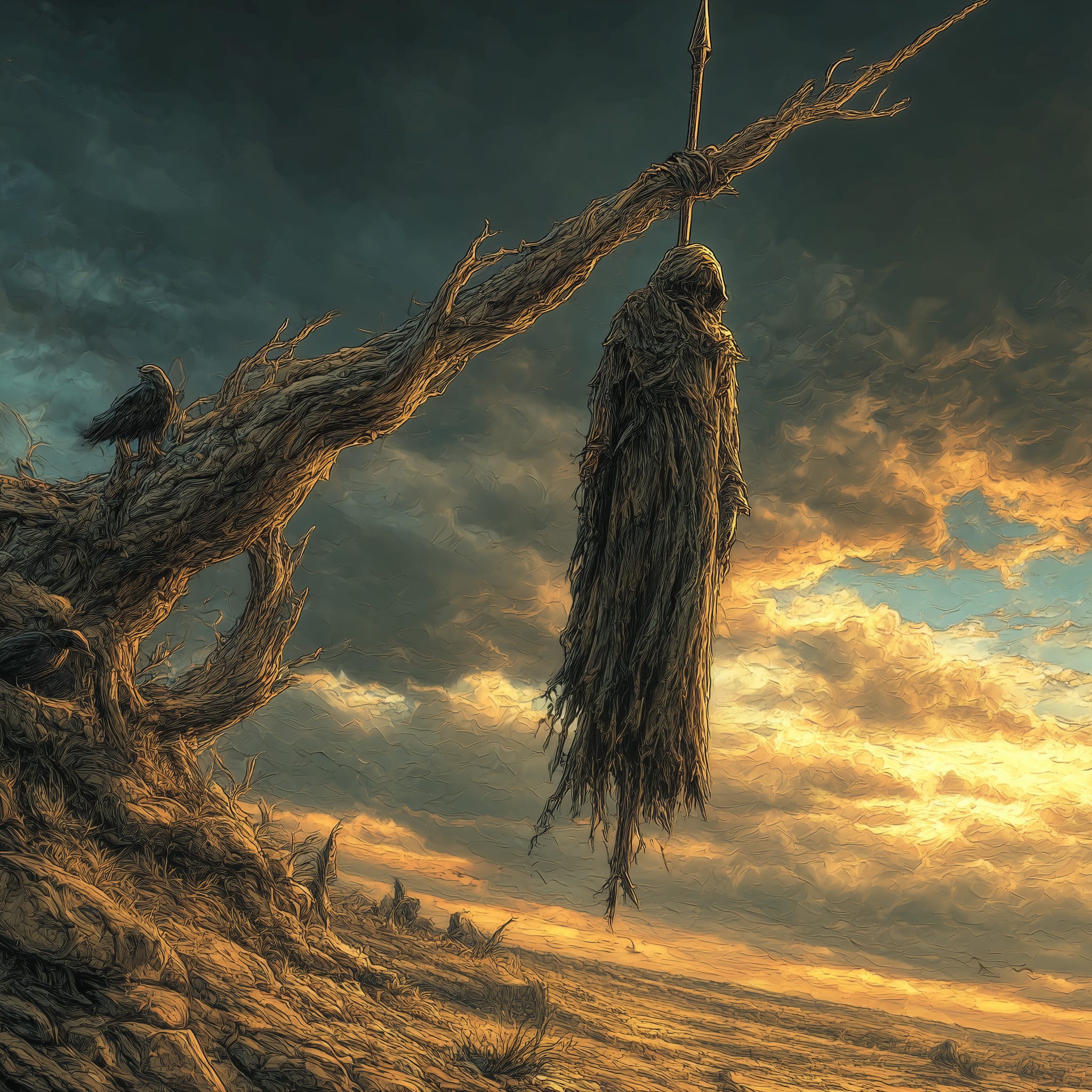
Christianity gave us a man who hung for everyone else. The Norse tales gave us a corpse that hung for itself. No forgiveness. No love. No moral intention. Just raw physical confrontation with the universe: Myself to myself.
Not a credo. A threat. An ultimatum to existence.
His silhouette does not shake.
It is the world that vibrates around him.
For every second he hangs, a new rule in the cosmos comes loose.
He did not hang to learn. He hung to force the universe out of alignment. This is not mysticism. It is violence. He wants to know everything, and he knows that knowledge does not exist as a gift or a truth, but as resistance. So he offers the only thing the universe responds to: a breach. Himself as the breach.
Nine nights in the wind, body emaciated, skin blown off like bark from a dead tree. The spear through the meat. It is not suffering. It is not asceticism. It is method. It is the only way to press through the membrane between form and information.
The runes did not come as signs.
They came as rifts.
Fault lines in reality.
Scars that think.
Structure in the Collapse
Ygg is not darkness. Darkness is absence. Ygg is pressure. An intensity that renders everything else secondary, including meaning, including the self, including any notion of a safe cosmos.
There are rituals that open gates.
This opened no gate.
It opened Everything.
Ragnarok is not a story to him. It is geology. It is law. It is coming, and he knows it, and that is precisely why he seeks not comfort, but structure in the collapse.
If everything is to die, he will know how. If everything falls, he will understand the mechanics of the fall. Nihilism is not his obstacle; it is his raw material.
Therefore, there is no morality in Ygg. Morality presupposes a center. Ygg is the absence of a center as an active force.
He does not hold onto identity. Identity is furniture. He overturns it whenever it stands in the way of what he wants. He wears a hundred and fifty names like masks, shedding them as he walks. As he declares in Grímnismál: “Now am I Odin, Ygg was I once.” Before he was the frenzy, he was the Terror.
He loses language before he loses his body. The words fall off him like singed feathers. Only tones remain—
short circuits, impulses; every sound a rune, every rune an injury.
To learn seidr he becomes a woman. To steal the mead he becomes a worm, an eagle, vapor, sliding through the cracks in the world. To understand death, he himself must be dead—
not symbolically, not ritually, but factually, completely absent as a subject.
Everything in him is transformation. Everything is dissolution. This is not poetry. This is ontology. To know more, something inside you must die.
The Usurper
The landscape betrays him. Look at the ancient names etched into the soil—Torshov, Ullensaker (both Norway). The fields belonged to Thor. The laws belonged to Tyr, the original Sky Father, the steady pillar of justice. Odin has no roots there. He is not the ancient foundation.
He is the parasite that grew upon it.
He is an upstart. A dark wind blowing from the south, sweeping aside the gods of order not because he was better, but because he was more ruthless. He stole the throne of the sky. He reduced Tyr to a maimed soldier and claimed the title of “Father” for himself.
It was a cosmic coup. Why did we let him in? Because the world broke. He is the god who ascends when civilization collapses. He rose from the trauma of the great migrations, the Fimbulwinter, the time when laws meant nothing and survival meant everything. When the world burns, you do not pray to a judge like Tyr. You pray to a monster.
Knowledge as a Wound
He hangs and the wind tears and the runes bleed and mullions crack in everything called order
it is not night it is not day there is a furious noise under the skin
and the body is a mistake the body is an obstacle and the eye is a mouth and the tree is a throat
and everything falling down is actually falling inward
and he is not hanging he is dissolving and thought loosens from thought
and there there there
it opens—
—and knowledge takes the form of a wound.
When he finally lets go of the tree, it happens soundlessly. No one falls as quietly as that which was already dead before the hanging began. The earth does not crack. It pulls away.
The Breaking Point
Ygg is not a god. He is not a “he”. He is the moment you stand too close to the edge and your head says: Don’t pull away.
It is not temptation. It is information.
You have never been safe.
Safety was a construct you allowed yourself to keep because you weren’t ready yet.
Under him, there never was a tree. It was a breaking point in the cosmos. A crack deep enough to speak.
And the voice you heard? It was your own, but flayed.
Ygg is the ritual that demands you choose what must die inside you for you to understand more. Some sacrifice fear. Others pride. Some sacrifice the mind.
Few come out whole. Those who do, lie.
Snorri built a cage around this. He had to. A society cannot live with a god who dissolves the subject as a condition for knowledge. A world cannot function if wisdom always requires amputation.
But when you tear away Snorri’s prose and stand face to face with the Norse darkness, you see what they really knew: Odin was never a god of victory. Never a god of wisdom.
He was the will to knowledge as destruction. He never gives you anything. He takes something from you, and what you are left with, you call insight because you have no other language left.
The last thing to vanish is your voice.
Not because you lose it—
—but because the text takes it.