


There’s a strange obsession in genre-land: the moment a story has darkness, brutality, hunger, or sex, suddenly it’s grimdark.
As if anything that isn’t polished high fantasy genre-slop must be shoved into the same worn-out label. It’s like watching a sommelier swirl a vintage Burgundy, sniff it, and declare: “Yep. Red.”
Technically correct. Substantively: utterly clueless.
For me, grimdark has become a kind of catch-all word. When people stand in front of a text that doesn’t bend to moral comfort, that doesn’t excuse desire, that shows what structures do to people and what people do to structures, they shout:
“Oh! Grimdark!”
As if it’s some kind of literary sludge: darkness for the sake of darkness, blood for the sake of blood, nihilism dressed in academic robes.
The problem is: that’s just not true.
To explain why, we have to start with what grimdark is actually built on.
Grimdark is cynicism as scenery
Grimdark has one basic tone:
The world is shit, no one gets better, and everyone does whatever they must to survive.
It’s consistent, sure. But it’s also pretty flat. A kind of fatalism. Hard but without height. Dark but without depth. It hits, but it hits flat. It doesn’t resonate.
It’s pulp. In small measures, fine. But it doesn’t carry its weight.
And I’ve never been interested in that.
What I write has darkness, yes, but it’s never for shock value. I abhor slow motion in general, and grimdark is all about shock value and blood-splash in slow motion.
Grimdark rarely has eros
…and if it does, it’s disfigured
This might be the biggest difference.
Grimdark loves turning sexuality into:
abuse
degradation
shock
torture
sadism
nihilistic sex without meaning
What I write uses eros as:
ritual
law
politics
metaphysics
ecology
binding
I don’t write eroticism as decoration, or shock, or taboo-for-clicks. I write it as architecture.
Body as treaty.
Desire as geology.
Consent as civilization-building.
Union as realpolitik.
Ritual as mythology.
Show me a grimdark novel that does that.
I write ontology, not aesthetics
This might be the most important part:
Grimdark describes surfaces.
I write substrata.
What I write is:
power and body
ritual and law
nature-force and state
ecology and psyche
eros as system
mythology as realpolitik
realpolitik as bodily cooperation and conflict
A universe where everything is connected like geology, not like plot tricks.
I don’t write dark to be dark.
I write dark because the light can’t survive lies.
It’s a whole new genre. I propose to call it mythic-erotic realpolitik.
Finally: why the misunderstanding happens
…and why The Jotun Bride is different
People call darkness grimdark because they don’t have another word.
They use the closest box they know.
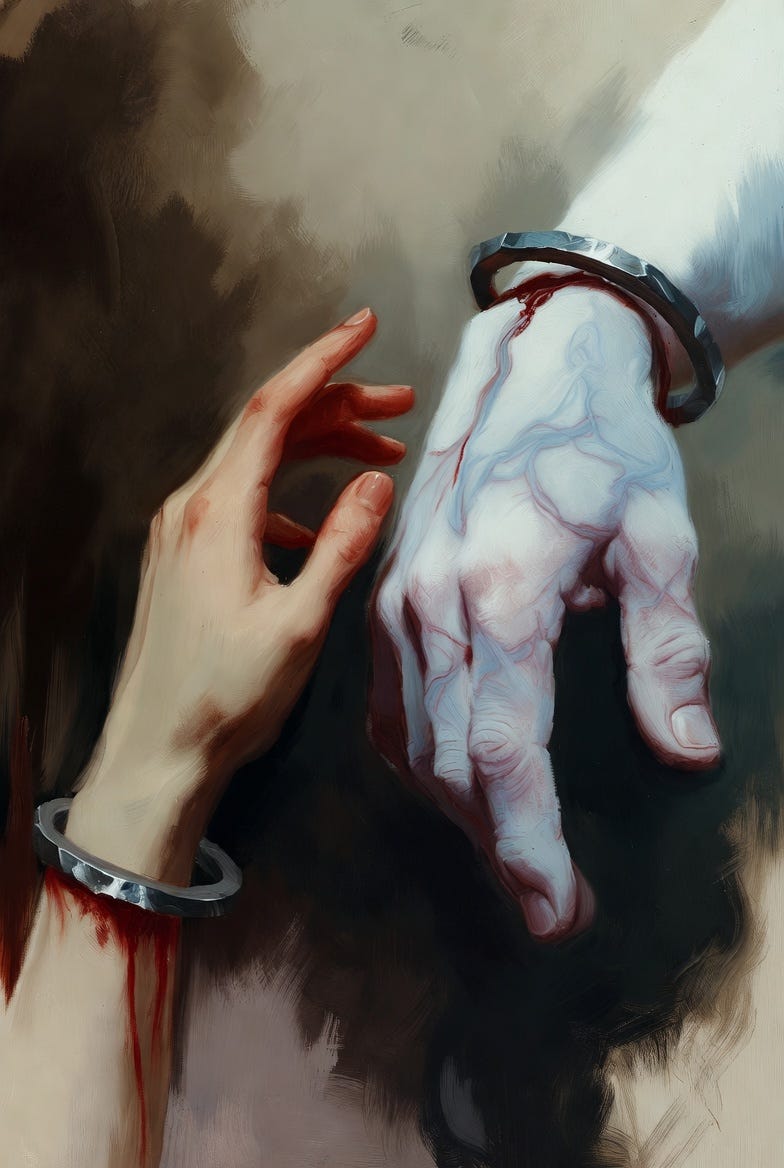
But my book isn’t dark out of cynicism.
It’s dark out of necessity.
It’s erotic out of intention.
It’s violent out of economy.
It’s political by nature.
It’s mythic by biology.
That’s an entirely different direction.
If you love stories where power isn’t a cardboard cutout, where eros isn’t garnish, where mythology isn’t a costume, where violence has ecology and consequence, and where humans meet natural forces with body, blood, will, and fallibility—
You’re reading something new.
And it burns.
The Jotun Bride is mythology with teeth. Razor sharp ones at that.
If you’re tired of darkness without depth, of fantasy that flinches from what power actually costs, of worlds where eros is either absent or abused—
This might be the book you didn’t know you were waiting for.
The Jotun Bride is due out in a few days.
Well I like what PJ Ashton writes even though it can get very scary at times.
Hope you'll enjoy the new novella next month! 😊
Fine. I guess you won't be a fan of The Ossuary Job feat. myself as Abi of the Ossuary and going live next month! 😝