


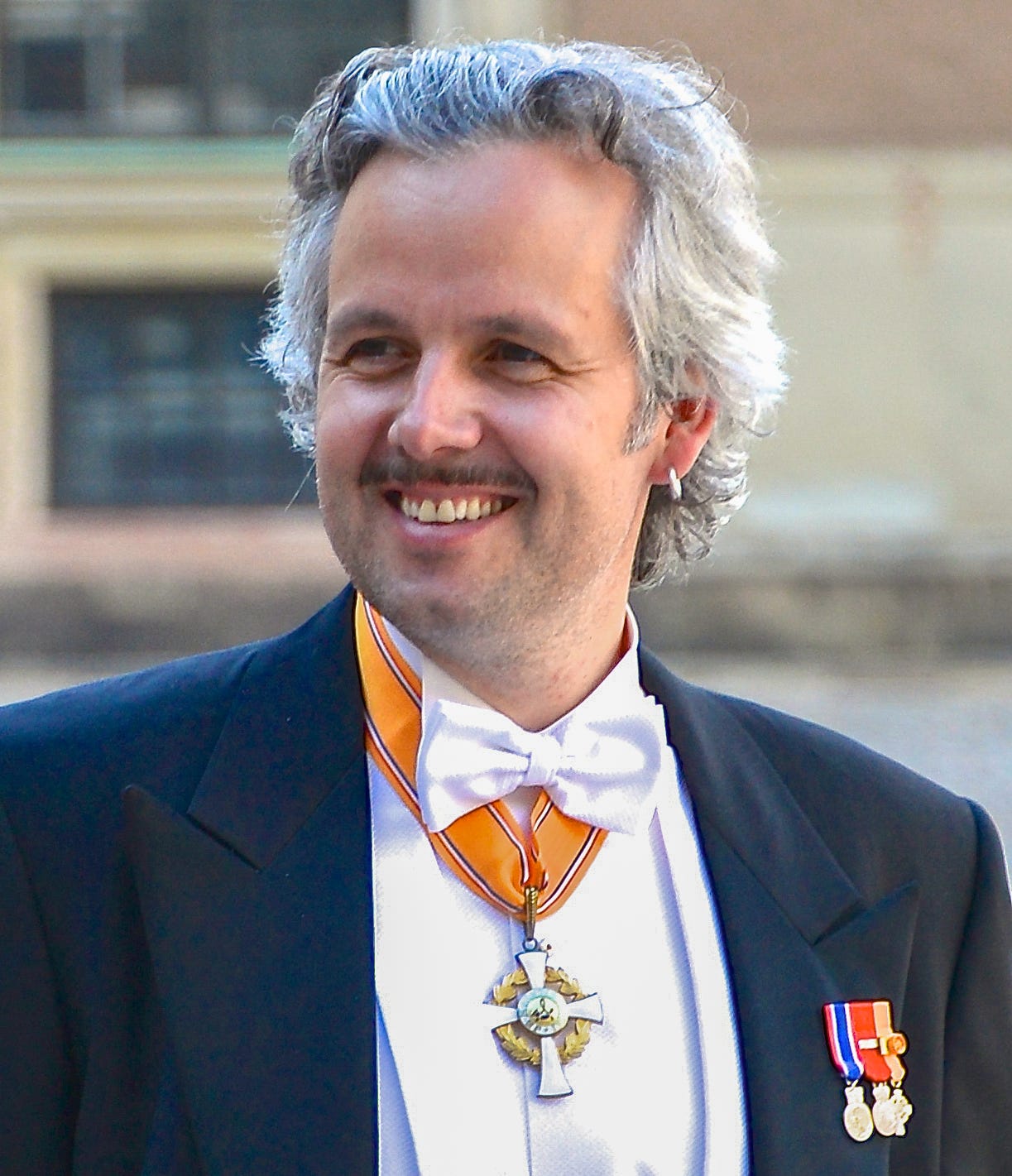
Ari Behn didn’t disappear. He was replaced.
First by a persona, then by a symbol, then by a story so tidy it could survive without him.
For most of the world, he exists now as a set of headlines: the commoner who married into royalty, the velvet-suited exhibitionist, the cultural peacock, the suicide.
It is a fiction that survives better than the person it replaces: a mascot and a corpse repurposed as cultural wallpaper.
To understand the real tragedy, you have to look past the “victim of the press” narrative. Ari Behn wasn’t simply wounded by the cultural machinery; he collaborated with it. He fed it, mocked it, depended on it, and was eventually consumed by it.
The tragedy isn’t that he was misunderstood. The tragedy is that he became so entangled in the reflections of himself that no one could tell where the mirror ended and the man began.
Least of all Ari.
The Omen in the Debut
Sad As Hell
In 1999, Trist som faen (Sad as hell) hit the shelves like someone had kicked open a window in a stale room.
Young men who had grown up on grey realism suddenly had someone who wrote with swagger, desperation, and sweat. The book sold in numbers Norwegian debuts don’t sell in. Critics bowed. “New wine,” they said. For a brief moment, he stood a chance. Because the man who wrote those stories wasn’t a symbol yet. He was just a writer with a sharp eye and a cracked heart.
But the final story in that book already contained his future. In the titular piece, two men try to impress each other with stories of meaningless sex and the hollow performance of coolness. The verdict delivered by one of the characters is devastating:
“Jævlig teit, spør du meg.” (”Damn stupid, if you ask me.”)
He knew the trap before he walked into it. He saw the emptiness of the poseur, the man performing a version of himself until the mask fuses to the skin. That line is not a critique of a character; it is an omen. Ari saw the emptiness of the persona. And then, driven by a hunger he couldn’t name, he built one anyway.
The Royal Disaster
Entering the Hyperreal
People say marrying Princess Märtha Louise in 2002 destroyed his career. That is too simple. What it did was worse: it turned him into a sign.
A symbol cannot write literature. A symbol can only be consumed.
The grey custodians terrified of appearing unserious—the ones that call themselves the Norwegian cultural establishment—panicked. A writer in their midst had crossed into kitsch territory. Royalty is tabloid territory, and tabloid territory is cultural contamination.
The reviews shifted overnight. The question was no longer “Is this book good?” but “How dare this man, this decorative object from the gossip pages, attempt literature?”
Cathrine Sandnes (Dagsavisen) didn’t just critique; she snickered at the audacity of his existence. Her review stands as the formal indictment. The headline itself was pure mockery: “Soap Opera in the Sahara.”
She didn’t settle for calling the book bad; she reduced it to cultural trash, describing the dialogues as something resembling:
“...den norske oversettelsen av en middelmådig såpeopera.” (...the Norwegian translation of a mediocre soap opera.)
But the insult wasn’t aimed at Ari alone—it targeted the system that enabled him. Sandnes pointed directly at the publisher, Torleiv Grue at Kolon Forlag. She implied that Ari Behn wasn’t treated as a writer to be developed, but as a commodity to be shipped out. Then she posed the killing question:
“...om forlaget har klart å gi forfatteren den motstanden han kunne ha trengt.” (...whether the publisher managed to give the author the resistance he might have needed.)
It was mercilessly precise. Sandnes exposed another part of the machinery: the cynical quiet. The publishing industry knew the book wasn’t finished. They knew the language was unpolished. But they also knew that Ari Behn was “hot,” and that the book would sell regardless of quality. By denying him resistance—the critical editing that makes a writer better—they did not show him respect. They showed him indifference. They allowed him to publish an unfinished text, fully aware the critics would tear him apart while they pocketed the sales.
The Siege
If the rejection in 2003 was a reaction, the subsequent years were a siege. The establishment didn’t just dismiss him; they hunted him.
By 2015, nearly a decade and a half into his “royal” existence, one might expect the cultural elite to have softened, or at least grown bored. They hadn’t. When Tiger i hagen (Tiger in the Garden) was released, the animosity was as fresh as a new bruise.
In Fædrelandsvennen, critic Vilde Imeland didn’t just give the book a low score; she attempted to invalidate his entire existence as an artist. She declared Ari to be the ultimate Norwegian example of a paradox:
“...en forfatter med et navn, men uten litterære evner.” (...an author with a name, but without literary abilities.)
The cruelty was specific and infantilizing. She warned readers that anyone fooled by the media coverage would be subjected to texts:
“...på nivå med en skolestil – skrevet av en tiendeklassing som er mer interessert i å bli ferdig enn å få gode karakterer.” (...on the level of a school essay – written by a tenth-grader more interested in finishing than getting good grades.)
But the true violence lay in the institutional gatekeeping. It wasn’t enough to kill the book; she had to shame the publisher for letting him in the building. She turned her sights on Kolon Forlag, accusing them of prioritizing:
“...middelmådige, middelaldrende forfattere uten snev av litterær potens.” (...mediocre, middle-aged authors without a shred of literary potency.)
Uten snev av litterær potens. Without a shred of literary potency.
This is not literary criticism. It is a public castration. It is the sound of a culture telling a man that his voice is not just bad, but illegitimate. That he is taking up space meant for “real” people. Even thirteen years after the wedding, the machinery was still grinding his bones to make its bread.
The Butcher and the Prophecy
Marta Norheim (NRK), a heavyweight critic sometimes playfully called NRK’s “bøddel” (butcher), followed in kind. She sniffed at the lack of “substance,” reading the celebrity rather than the sentences. She accused him of trafficking in clichés, suggesting the book lacked soul.
But it was in a debate titled “Hvor god er egentlig Ari Behn?” (How good is Ari Behn, really?) that Norheim delivered a line that revealed her critical posture with unnerving clarity. When discussing how to approach a writer who was still alive—still volatile, still culturally radioactive—she said she preferred dead authors. Then she quoted Georg Johannesen:
“En kritiker må skrive som om han er død.” (A critic must write as if he is dead.)
It was intended as principle. It landed as prophecy.
After Ari’s death, it was the same Norheim who praised Vidar Kvalshaug’s book about him as “fascinerande og mangesidig” (fascinating and multifaceted) and who appeared in NRK’s own promotion calling it “klok og hjerteskjærende” (wise and heartbreaking).
The shift was instantaneous. The tone transfigured. The man was finally acceptable—as myth.
VG and Dagbladet—the twin custodians of cultural decay—stopped reading the text and started reviewing the silhouette. They committed the cardinal sin of criticism: they evaluated the aura, not the work. But here is the harder truth: Ari helped them do it.
He fed the cameras. He leaned into the absurdity. He made himself a spectacle because he feared invisibility more than he feared ridicule. He became hyperreal. A Baudrillardian copy of a copy: the man playing the man playing the man.
Once you become hyperreal, you are no longer allowed depth. You are a character in the public’s dream, not the author of your own story.
The House That Eats Its Own
The polite fiction is that Ari Behn simply “didn’t fit in” with the Royal Family — as if the issue were taste, not structure.
That is the version the monarchy prefers, because it suggests a neutral mismatch, a regrettable error of chemistry.
The truth is uglier. He didn’t fail the monarchy. The monarchy rejected him on sight.
But not openly.
That would have required a vulnerability they do not possess.
No, the Norwegian Royal House operates on a more insidious principle: the violence of silence. They don’t stab; they suffocate. They let you learn, slowly and humiliatingly, that warmth is not coming.
When Ari admitted in interviews that he was on bad terms with his in-laws, the public smirked. They shouldn’t have. They failed to understand that a monarchy is not a family. It is a fortress of curated bloodlines, an institution that survives by pretending it is above the psychological messiness of real human bonds.
They welcomed Ari the way museums welcome exotic artifacts: admired from a distance, useful for the brochure, but never touched without gloves.
They loved the symbolic potential — the bohemian outsider who made them seem modern — but they recoiled from the man. From the moment he stepped inside, he was treated like a culturally dubious import: tolerated, contained, and corrected.
His warmth read as threat.
His humor read as disrespect.
His unpredictability read as contamination.
The monarchy prizes one trait above all others: predictability. Ari was a live wire. And in a house built on ancient timber, live wires aren’t scolded; they are isolated.
The palace didn’t destroy him through cruelty. It destroyed him through indifference. Indifference cannot be confronted. You cannot argue with a glacier.
And here is the rot at the core: the monarchy requires people who can suppress themselves to serve the image. Ari needed a life where he could expand to serve the self. He married into an institution that punishes intensity, flattens personality, and treats authenticity as a breach of security protocol.
He was doomed the moment he walked through the palace doors. Because the monarchy can tolerate eccentricity — but only in decorative doses. Ari wasn’t decorative. He was alive.
And nothing threatens a rotten and dead institution more than a man who insists on staying alive.
An institution that calls itself “protective” while shielding abusers and erasing the harmed; a moral architecture long overdue for collapse.
The Contradiction at the Core
Norway didn’t know what to do with a man who wanted to be both clown and prophet. Ari didn’t know what to do with it either.
He was a man in permanent, agonizing oscillation. He despised attention and needed it like oxygen. He mocked celebrity and courted it. He wanted to be the serious outsider, but he married into the ultimate insider institution. He wanted artistic gravitas, but he also wanted to throw himself into the circus ring and demand everyone watch.
He aestheticized his pain until the pain ceased to be symbolic and became literal.
When he wrote Entusiasme og raseri (2006), it was an attempt to expose the media machine, to reclaim agency through satire. But satire is impossible when the public already thinks you are your own parody. He tried to puncture the myth of himself, but myths only regenerate.
Eventually, the persona became airtight. There was no exit.
Inferno: A Containment Breach
By the time he wrote Inferno (2018), the writing was no longer filtered through performance. The persona had failed him. The mask had liquefied.
It was a signal flare. A man burning, drowning, disintegrating.
“I am a clown, in the worst case. In the best case, I am a debater and public figure.”
But the critics saw only melodrama. The public saw only a peacock in his final display. They mistook the emergency beacon for yet another pose. This was not just cultural cruelty; it was cultural blindness. A society trained to interpret him only as a symbol could no longer perceive the man even when he stopped trying to hide.
He wasn’t unheard.
But he was unreadable.
The Machinery
If we are to dissect the body, we must identify the weapons. Ari Behn was torn apart by a specific alignment of forces:
Cultural Fragility: an intellectual elite terrified of endorsing someone who risked making them look unserious.
Media Economics: a personality who generated engagement by suffering publicly. His instability was marketable content.
Kierkegaard’s Despair: the despair of the self that tries to create itself entirely through the eyes of others, until the pattern becomes too tight to breathe in.
A Warning
Ari had many chances. He kept reaching for them, and he kept dropping them like confetti.
He wasn’t destroyed by the system alone. He rushed toward it, desperate to be seen, and was met with machinery that only recognized silhouettes.
Ari Behn is what happens when a culture demands symbols instead of people, performances instead of souls. He didn’t die as the character they cast him in.
Not the peacock.
Not the clown.
He died when the role devoured the man who played it.
And when he took his own life, the same media that mocked him fell silent. By morning he had been rewritten into a myth, his critics quietly sweeping their old condemnations under the national rug.
This isn’t a lament.
It’s a warning bell for anyone who mistakes visibility for survival.