


Snorri didn’t invent Loki’s monstrous family. He simply took the scattered bones, washed them clean, and wired them together into a museum exhibit. A neat triad, a mythological kit assembled. The wolf, the serpent, the death-maiden. All tagged, labeled, tucked onto the proper shelf.
And scholars have been wandering through his showroom ever since, nodding obediently.
But the older poetry doesn’t nod. It snarls.
Before Snorri’s narrative taxidermy, the “family” wasn’t a family at all, but a flickering constellation of metaphors, kennings, sibling-hints, and poetic side-eyes. A cluster of shadows moving just outside the circle of firelight. The task is not to reconstruct Snorri’s story; the task is to stand still long enough to notice the shapes the shadows actually form.
You have to let the darkness speak its own grammar.
A family that didn’t know it was a family
Start with the wolf. The oldest poems don’t whisper; they outright bark that Loki fathered him. Haustlöng slaps the label on as if it’s obvious. Loki is “ulfs faðir.”
No mythic biography. Just a casual confirmation that the trickster-god carries a monster under his ribs.
Then Hel steps into the frame, but not as the sanitized goth princess Snorri hands you later. Instead she is an older, sharper presence that moves through the kennings like a cold draft. “Loki’s girl.” “Sister of the Wolf.” A death-thing with family ties the poets don’t linger on because everyone already knew: you don’t stare too long at whatever shares blood with Fenrir.
The Wolf and Hel. A cluster of dread orbiting Loki like broken moons. Already a dangerous pattern, even before the serpent coils its way in.
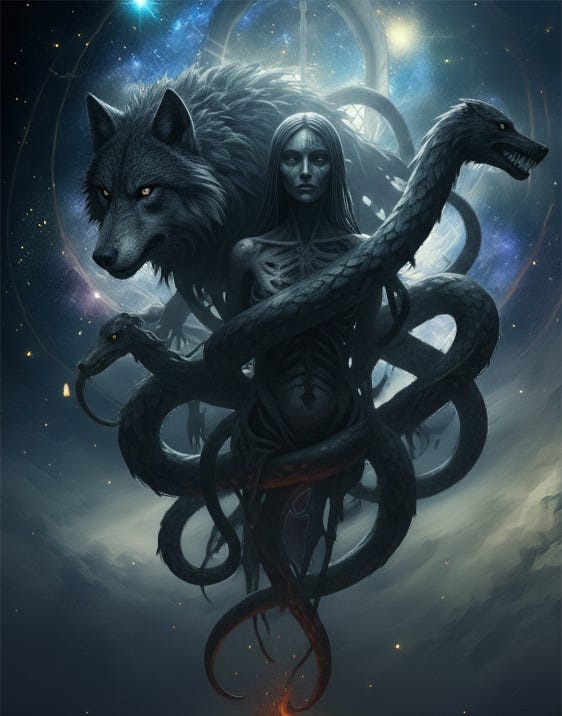
Then they were three
Jörmungandr doesn’t enter through the front door. There is no line in the early poems saying “Loki begat the world-serpent,” neatly phrased for the benefit of future graduate students. What we get instead is something far more interesting and far more Norse: a kenning that refuses to sit still.
“Father of the sea-thread.”
A quiet detonation in Þórsdrápa.
A poet’s way of saying, “If you were paying attention, you’d know who sired this thing.”
And Hymiskviða doesn’t describe the serpent as Loki’s child It’s just a sideways confession where it calls it the wolf’s brother. A single sibling-marker tossed like a bone across time. But once you see it, the implications snap shut like a trap: if the serpent is the wolf’s brother, and the wolf is Loki’s son, then the sea-thread coils into that same family whether it likes it or not.
This isn’t Snorri’s tidy genealogy. It’s older. Stranger. A family discovered by triangulation, not declared.
The earliest poems don’t prioritize their paternity as a biographical fact. They’re too busy staring at its body, stretching around the world like the boundary of sanity itself.
They call it a ribbon, a ring, a fish big enough to strangle land. They fear it for its form, not its lineage. To force Snorri’s biographical neatness back into these verses is like trying to staple a birth certificate onto a storm.
So what did Snorri do?
Enter Snorri Sturluson, medieval myth-maker, Christian bureaucrat of chaos.
He took one look at the swirling poetic cloud and said: enough.
He introduces Angrboða like a forensic pathologist bringing in a missing mother. He takes the scattered poetic hints and welds them into a triptych of doom.
Neat.
Symmetrical.
Biblical, almost.
Loki + Angrboða = Fenrir, Jörmungandr, Hel.
A brood with purpose, a cosmic crime-family destined to tear the world down.
He even domesticates them, briefly, like a man trying to prove he’s not scared. He turns the serpent into a cat. Fenrir into a house-dog. It’s a nervous joke, the kind people make when they’re standing near something that could swallow the sun.
But underneath the humor lies the real revelation: these monsters are not outside enemies. They come from within the divine community.
They are extimité made flesh. The intimate foreignness everyone pretends not to notice until their walls crack. Loki’s children are not apocalyptic because they are monstrous. They are apocalyptic because they are inherited.
And then we arrive at the truth
The truth surfaces beyond Snorri’s systematization, as it always does.
He may have organized the family tree, but the poets knew the deeper terror long before he set quill to parchment: the end of the world won’t come marching from Jötunheim with a banner.
It will rise from within the gods themselves, from the blood they share and the lies they tell about where danger truly begins.
Loki’s brood are not outsiders. They are the shadow-children of the divine, the parts of the Æsir they banished, mocked, minimized, or tried to bind. The serpent encircling the world. The wolf gnawing its chains. Hel waiting with the patience of ice.
The family Snorri “discovers” already existed in the poetic pressure that builds whenever a culture senses the monster is not out there, but in the room with you.
And when Ragnarok comes, they are part of the revelation.
Thank you for reading.
Please leave a comment.
I quote Snorri himself: If Thou Neglect’st To Leave A Comment, Ragnarok Shall Commenceth Forthwith.
Always been a big fan of Norse mythology. I draw a lot of that influence with some of the characters i write about. Well written stuff