


Kaldhall is not a safe space.
But it is an honest one.
A place for those who know that “escape” does not mean “free of cost.”
This is not a brochure for a safe space. Kaldhall is not haven for queer souls. It is worse than that, but—
it’s better than reality.
We are speaking of a hall where the mountain itself sorts bodies, tests nerves, uses some, discards others, and yet ends up as one of the most mercilessly liberating places a queer reader can escape to. Not because everyone survives beautifully.
But because body shame has no place here. Only substance and Will remain.
In the Hall, no one speaks of “M/F/X” or “orientation” as something requiring a committee meeting. They have another language: Ice-Born. Smoke-Born. Stone-Born. Resin-Born (and more).
These are not pronouns. They are climates.
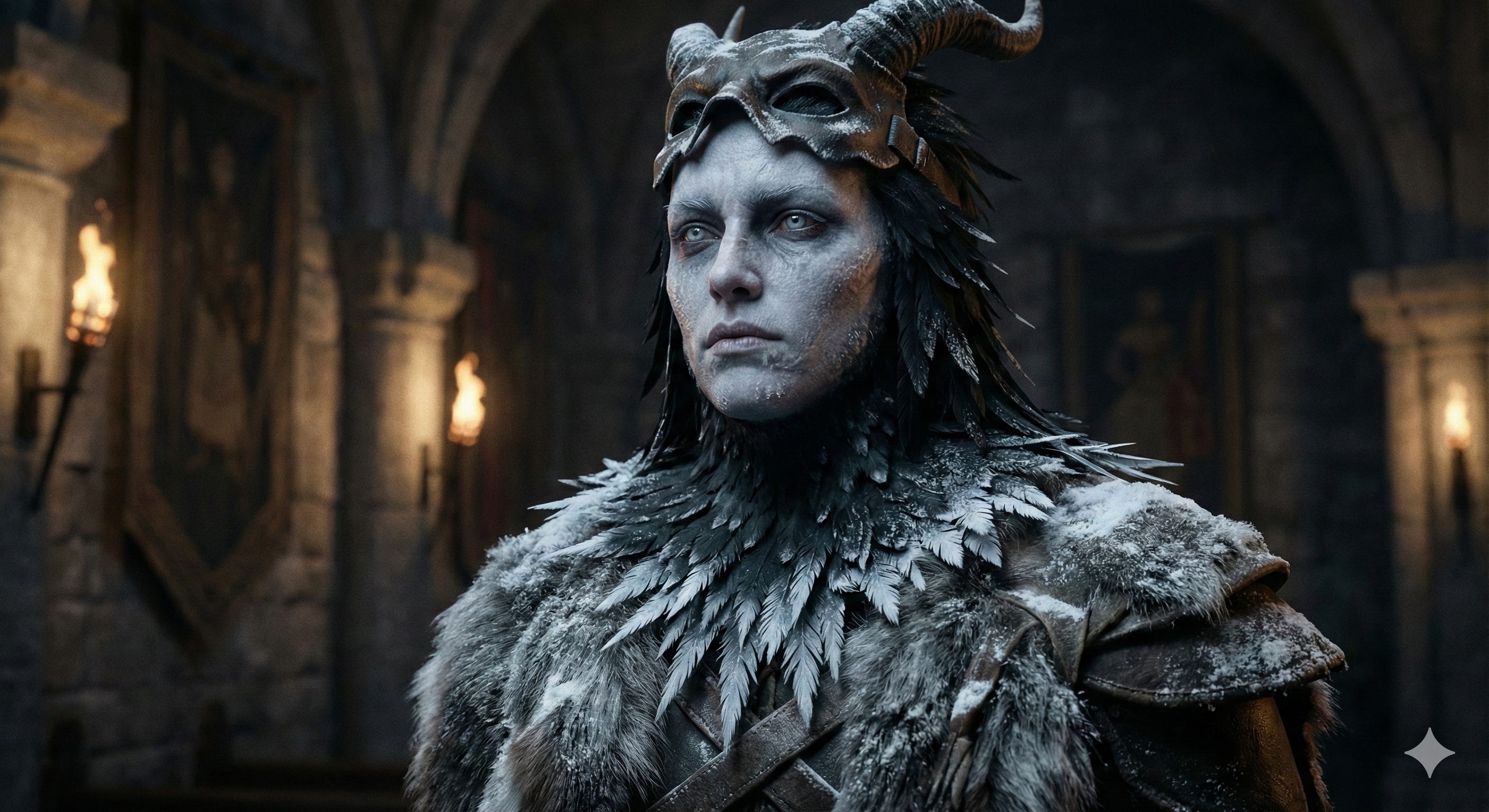
Crow enters the circle as “she” and leaves as something that breathes mountain. Gromr crawls out of the mountain’s body as a tool—frost-veins in stone skin, shaped for pressure and obedience. The failed births are broken at the neck and returned to the mass. No memorial service. No moral panic.
Identity is not “which box do you want to tick today,” but: what pressure can you withstand? What can your body become? And what does the mountain do to you when you say yes? Or simply stand too close?
For a queer reader used to forms, diagnoses, categories, laws, family gazes, and HR meetings, this is a perverse relief: Here, you are represented. Here, you are reshaped.
Queer Metamorphosis Without the Duty to Explain
Crow is the mirror the reader first recognizes: a sudden body, no past, feathers and skin in the wrong mix, found naked in the snow and dragged into the hall.
She receives:
Serpent-hands on her body, examined without shame.
A ritual where the mountain presses into her, through her, claiming her nerves.
A new breath: “Not girl-breath, not boy-breath. Mountain-breath.”
It is the classic trans/non-binary narrative, but stripped of dead names, TERF debates, and legal gender markers. The body changes. Language tries to catch up. No one stands with a clipboard asking “what does this mean for narrative representation.”
She emerges as Ice-Born. Not fully defined, but irrevocably changed. Mountain-approved, but not mountain-owned. “What am I, truly?”
The answer is honest: “That is for you to decide.”
There, in the middle of a violent cosmic machinery, she is given a freedom that exceeds reality: There is no “correct” way to be Ice-Born. No manual. No list of expectations. Only: What can you live as in this form?
The System Is Not Kind
Just More Honest Than Yours
But Kaldhall does not lie about the price. Crow’s journey is not standard. She is one of the ones who comes out well.
Others do not.
In the deep, where the mines bleed into the mountain’s wet interior, we find Hrymfótr:
Six-legged, experienced miner.
Dragged into the mountain’s throat.
Dissolved in heat, pulse, and darkness.
His heart rewired to the mountain’s rhythm.
He does not “die.” He is held. He was not trapped. He was not dying. He was kept.
If Crow is the myth you want to hear, Hrymfótr is the log entry you were not meant to see.
The Mountain produces three bodies:
The Failed: No consciousness. Neck broken. Returned to mass.
The Husk: Physically perfect, but without spark. Slowly lowered and reabsorbed.
The Tool (Gromr): Usable, obedient, strong, with a hint of will. This one lives.
This is not an inclusive HR system. It is natural selection set to an industrial formula. And yet: no one moralizes over those who fail. They are not “sinners,” “perverse,” or “shameful.” Just: useless. Material. Sad, brutal—but not moralistic.
Kaldhall does not give you equal value. But it gives you more respect than your world does, because:
It does not shame you for what you want.
It only asks if you can handle the pressure. And even then: no social humiliation. You simply disappear.
It is dark. But it is cleaner than the social violence of real life, where people smile, vote “for diversity,” and still demand that you be understandable, presentable, and compatible with the employee handbook.
The Steward, The Wolves, and the Economy of Flesh
Seidhra (The Steward) is Kaldhall’s most dangerously queer figure. She:
Keeps the ledger of bodies that endure.
Snaps the necks of failed products without drama.
Kisses the throats of new candidates, marking them with tongue and smoke.
Calls Gromr “mine” with the same certainty that the mountain claims him.
She is not a feminist icon. Not a moral compass. She is the middleman between cosmic will and social structure. And she is irresistibly hot. That is the point: in Kaldhall, power takes many forms—but it is never hypocritical.
The Wolves are not a “queer pack” for Instagram quotes. They are a predator collective:
They test you on what you can withstand, not what you call yourself.
They accept you if you pass, not because you have the “right identity.”
Desire is logistics and ritual, not a “problematic issue.”
It is queer, but not kind. And that is precisely where it becomes a legible escape.
In reality, the queer body is always negotiated through moral language: “acceptance,” “inclusion,” “safe spaces.” You must be pedagogical, representative, understandable, likable.
In Kaldhall, the question is much simpler and harder: Does your form hold? Can you withstand the reshaping? Can we use you?
It is a sarcastic answer to reality’s performative inclusion: Kaldhall does not care about being “inclusive.” Therefore, it feels more honest to the reader who is tired of being a case study.
Why This Is Still Escape, Not Just Dystopia
So why does this hall feel like a sanctuary for queer readers, when people are chewed up, sorted, and sometimes thrown against the wall like wet waste?
Because:
Shame is removed from the equation. No one cares “why you are like this.” You are like this. Period.
The struggle is about capacity, not dignity. You skip “do I deserve to exist?” and go straight to “what can my body become here?”
Power is visible. The Steward’s ledger is open to us. The Mountain is not hidden behind pretty words. In reality, we wrap violence in policy language. Here, it is simply… practice.
The Metamorphosis is real. In our world: you change names, clothes, maybe bodies, but the systems around you remain the same. In Kaldhall: the world itself bends. The mountain breathes with you, the hall reacts to you, your name gains ontological weight.
It is not an escape to an idyllic paradise. It is an escape to a world that means it when it says: “You shall become something other than what they made you as.”
Icon, Not Paradise
So yes: Kaldhall is an iconic LGBT+/queer space—but not as a billboard for “everyone is welcome.” It is the icon for something else:
For the trans/non-binary reader: A body that changes not just socially, but metaphysically, freeing you from the duty to explain.
For the queer reader tired of “correct” representation: A world where desire needs no apologies, only ritual.
For anyone wanting to escape “identity as a brand”: A hall where you become climate, not category.
Kaldhall is better than reality in one concrete way: Here, the world does not gaslight you. It demands much, it can crush you, it can use you. But it is never fake.
The Icon’s job is not to promise that you will survive. The Icon’s job is to give you an image of who you could be, if the world around you dared to be as honest as the circle, the mountain, and the pack.
Kaldhall says: Come in, you who do not fit. You get no guarantee. But at least you get a world that doesn’t pretend it doesn’t know what it’s doing to you.