


You upload your magnum opus and the world doesn’t even blink.
You refresh your dashboard like it’s a heart monitor. Zero.
You tweak the blurb. Zero.
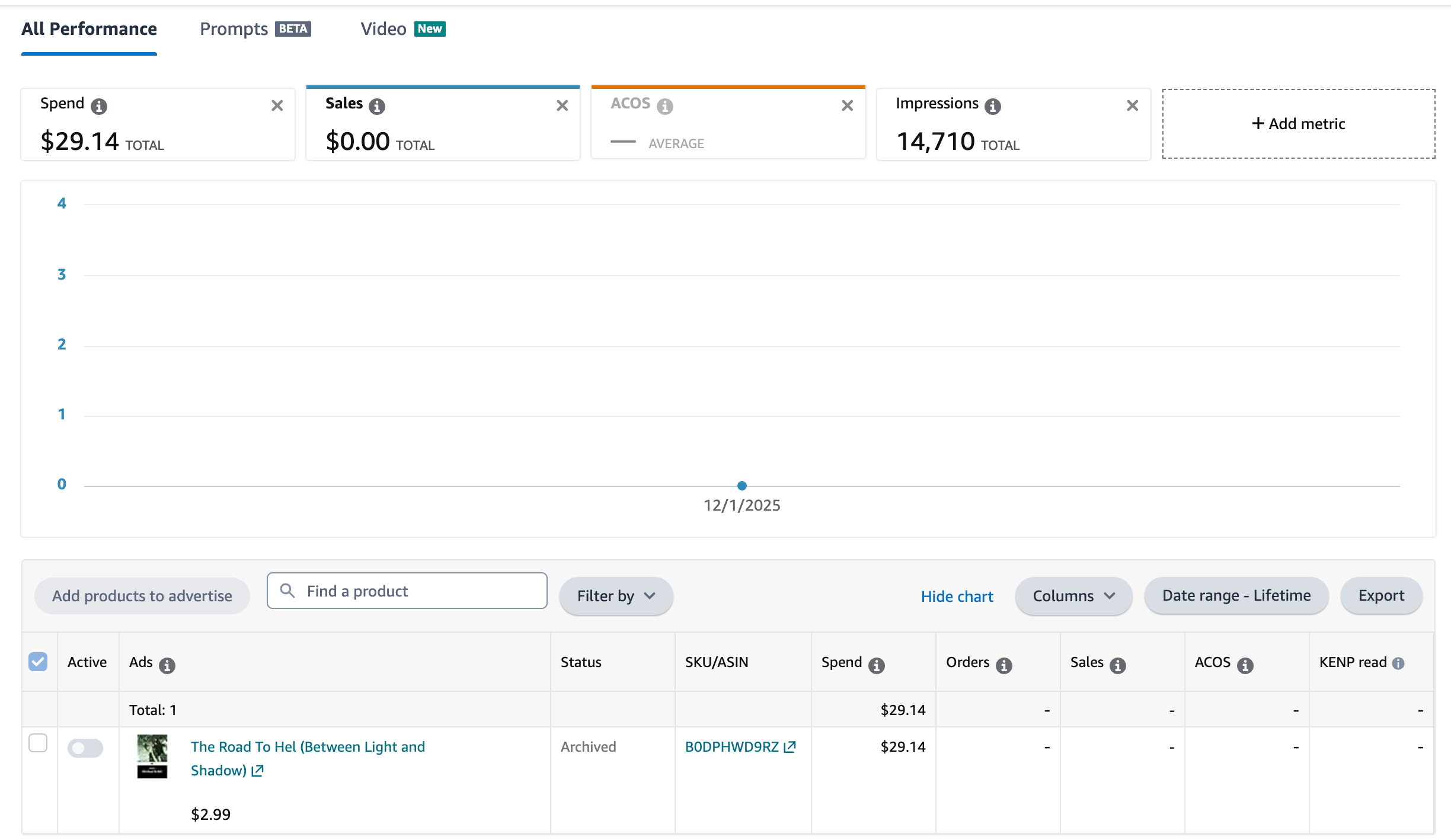
New cover. New keywords. A discount. An ad that quietly eats $20 while selling nothing.
Meanwhile a paperback titled “Keto Air Fryer for Seniors: 7-Minute Recipes” cruises past you.
That’s your first lesson on KDP:
Amazon doesn’t care that you wrote a good book.
It cares that your book behaves like a product.
So before you hit Publish, answer one question without flinching:
Are you here to write—
or are you here to win a war you didn’t start?
Because the war is the algorithm. And the first thing the algorithm teaches you is this:
You are not an author here. You are inventory.
Hundred Thousands Books Released Each Week
Amazon is packed with millions of titles, and more show up every day. Here’s what that means in real life: organic discovery is a fairy tale at the start. Your book isn’t “hidden.” It’s just irrelevant—until you either pay for attention or drag readers in from somewhere else.
And it’s not just more books. It’s sludge: low-effort churn, keyword-stuffed garbage, fake imprints, cloned covers. The platform rewards speed and signals, not the tormented writer who spent two years building a novella like a cathedral no one asked for.
So if your plan is “quality will rise to the top,” understand what you’re signing up for: disappointment.
New authors treat the product page like the finish line.
It’s not. It’s the cash register—where traffic either buys or bounces.
No traffic? No chance.
If you can’t send readers—ads, newsletter swaps, socials, community—you’re basically performing to an empty stadium, bowing to an audience that never entered the room.
And here’s the part nobody says out loud:
ads aren’t marketing. Ads are rent.
You can pay rent forever and still own nothing.
Sure, you can make it profitable—especially in tight genres with predictable cravings—but don’t confuse one good month with a real business. This machine can flip the table on you overnight.
You are not an author here. You are inventory.
The Ballad of the Writer Turned Content Machine
At first you wrote stories.
Not products. Not content.
Stories—
the kind you could lose an afternoon inside.
Then the platform taught you its hymns.
Post on schedule.
Write to market.
Aim the hook at the throat.
Smile for the algorithm.
And the question changed, softly,
like a friend who stops using your name.
Not: Is this true?
Not: Did I make something worth keeping?
Not: Will they remember me?
But: Will this convert?
Will this convert?
Will this convert?
Suddenly it’s all bright little instruments:
rapid-release calendars like rosaries
series hooks engineered to catch the click
genre signals stamped on cover, title, blurb
sometimes even the first page,
like you’re showing papers at the border
to enter your own book.
And the metrics,
the tidy cages with numbers for bars:
CTR, conversion, read-through, ACOS,
a lab rat’s alphabet,
a new way to be measured
until you start measuring yourself.
Will this convert?
Will this convert?
That’s how a writer becomes a content worker
who just happens to use sentences.
And the emails will come—
wolves dressed as helpers:
paid reviews,
guaranteed bestseller bundles,
guru courses,
one weird trick,
hope sold by the word count.
Delete them.
But the real scam is the one that feels like work
the one you run on yourself:
Next keyword.
Next cover.
Next tweak.
Next course.
Next “one last change”
before it finally clicks.
Will this convert?
Will this convert?
And here is the brutal truth, not shouted—
just said, like a nurse turning down a light:
you’ll need the stamina
to do this for years.
To watch the machine take your voice apart
and ask you, gently, to thank it.
And some mornings you’ll wake
with a sentence in your mouth
that tastes like ash—
and you’ll miss the old question
the way you miss a home
you didn’t know you were leaving.
Will this convert?
Will this convert?
You are not an author here. You are inventory.
Why Do It Anyway?
Don’t publish on KDP because you want to be seen.
By default, you won’t be.
Don’t publish for validation, momentum, or proof the years meant something.
That dashboard is a graveyard for those needs.
Publish only if one of these is true:
You want control.
You’d rather own the failure than rent a watered-down success. You accept that nobody owes you attention, and silence is the default response to sincerity.
You’re willing to become a machine.
You can write on schedule. You can repeat patterns without hating yourself. You can let metrics decide what survives. You understand consistency beats brilliance, and you’re ready to trade range for reliability.
You can lose illusions faster than money.
You know the platform won’t reward honesty, patience, or risk. You’re prepared to watch better work die quietly while louder, simpler books win—without turning bitter or fake.
Self-publishing is self-responsibility.
Enter only if you can live with the outcome—
whether anyone ever notices or not.
How To Be Seen
Here’s the part people will mess up: I’m not saying you’ll never be seen.
I’m saying you won’t be seen by default.
Silence is the platform’s natural state—and discovery is the exception that needs a cause: an audience you bring, a signal you trigger, or dumb luck you survive long enough to catch.
You are not an author here. You are inventory.
But here’s the flip-side to that statement:
Inventory can still win.
But not by begging to be noticed.
So Let Me Tell You How To Win
Start here: you need a small group of people who actually care about what you make. A thousand true fans.
If 1,000 readers buy your $3.99 book twice a year and you keep 70%, you’ve got a foundation. It won’t impress the internet, but it will pay real bills.
Because the algorithm isn’t impressed by your effort.
It’s impressed by conversion.
If you can bring 100 people to your page from your own list and 90 of them buy, Amazon’s brain clocks it. High conversion tells the system your book fits a real appetite, and it starts testing you in front of similar readers—for free.
In that scenario you’re not just fighting the machine. You’re training it.
But hear this clearly, because it’s where writers lie to themselves:
Ads are rent until they buy you something you keep.
A reader who will hear from you again.
A name you can call without paying a toll.
If ads don’t turn into an owned audience—newsletter, community, direct readers—then you’re not building a business. You’re feeding a meter.
Quality doesn’t rise to the top. But quality isn’t a myth. It’s a multiplier.
An average book with great marketing can sell hard for a month and then die when read-through is weak. A great book with average marketing can grow slowly for years because people finish it, talk about it, and go looking for the next one.
And yes—books can be discovered years later. Not because the platform is kind, but because the internet is chaotic and humans are contagious. A reviewer, a subreddit thread, a booktokker, a stray recommendation that hits the right person at the right time.
Base rate: silence.
Outlier: ignition.
So don’t build your plan on miracles. Build it so you can survive long enough to benefit from one.
Also: you don’t have to pick between being a tormented artist and becoming a content machine.
There’s a third lane: making art that’s commercial enough to be found.
You can write something emotional, strange, even experimental—and still package it in a way that signals its closest genre. This is not selling out. This is putting a sign on the door so the right readers know they’re welcome. Once they’re inside, you can be as weird or literary as you want. The border guard is the cover and blurb. The country is the book.
The people who try to beat the platform at pure volume often burn out. Five to ten books a year, then the wall.
The alternative isn’t “slow and broke.” It’s steady and compounding:
One strong book every year or two, over a decade, becomes five to ten books that keep earning. Each title is a small stream. Together they turn into something that can cover the “rent” of ads with the “dividends” of older work.
That’s what a real business looks like when you refuse to hollow yourself out for the dashboard.
Yes, to Amazon, you become inventory.
The counterpunch is that you’re the only person who can write in your exact voice.
You have a monopoly on yourself.
The war is only unwinnable if you insist on playing the machine’s game.
Play the human game instead: earn a small, real audience, give them work that holds them, and let the platform respond to the only thing it actually understands—proof of appetite.
That’s how you win.
And I wish someone told me this before I published.

Unfortunately I stopped reading because it sounded too damned much like AI. Definitely fit the profile of far too many email scam class pitches I see in how it was structured, whether written by AI or not. Apologies but I’ve seen too many essays like this and I start seeing stuff that is either wrong, out-of-date, or out-of-touch with publishing realities.
Here’s the deal, from someone who’s been in the selfpub trenches since 2011.
Do not do Kindle Select (aka Kindle Unlimited), UNLESS you are in a popular genre such as subsets of romance and military fiction.
Use other platforms such as Draft2Digital and Ingram Spark for distribution as well as KDP. Yes, that means you need to figure out cover art and formatting. But you should at least KNOW those basics before self-publishing (and don’t use KDP for print OR Ingram Spark for ebook. KDP print is lesser quality, that’s why it’s cheaper than Ingram, and Ingram’s ebook distribution is not as solid as D2D’s. Plus D2D gets you into libraries).
Do not throw money away on Facebook or Amazon Ads. Spend your money on editing and after that, cover art. If you don’t have money but you have a skill such as editing, graphic design, audiobook production, or layout…leverage those skills to swap for skills you don’t have.
Stay on top of the latest developments within the industry, both tradpub and selfpub. That means reading a lot of industry insider newsletters and blogs. Subscribe to Writer Beware so you know what the latest scams are.
Go where the readers are. That’s going to take some research. Engage with others beyond “buy my book!” Ask questions (I promise, despite my occasional snark, I don’t bite!). Network with other authors. Learn about the big sales like Naratress and others.
Realize that publishing, whether trad or self, is a LONG game, and so-called “overnight successes” usually have 10 years or more behind them. That’s the most important piece.
That's dark. But I like dark.