


Most of us think of writing as a cerebral act. We sit at the desk, hunched over the keyboard, letting thoughts spill into words. The body is only scaffolding, a silent frame that holds us up while the real work happens in the mind. But every so often, there are moments in art where the body itself enters the work, where the physical form becomes both medium and message.
One of the most extreme examples of this is Christian Bale’s transformation for The Machinist (2004). The role demanded that he appear as a man wasting away: a factory worker consumed by insomnia, paranoia, and guilt. To inhabit this figure, Bale starved himself until he was scarcely recognizable. His diet has become the stuff of film legend: one can of tuna, one apple, black coffee. Day after day. Week after week. Until he stood before the camera like a living skeleton.
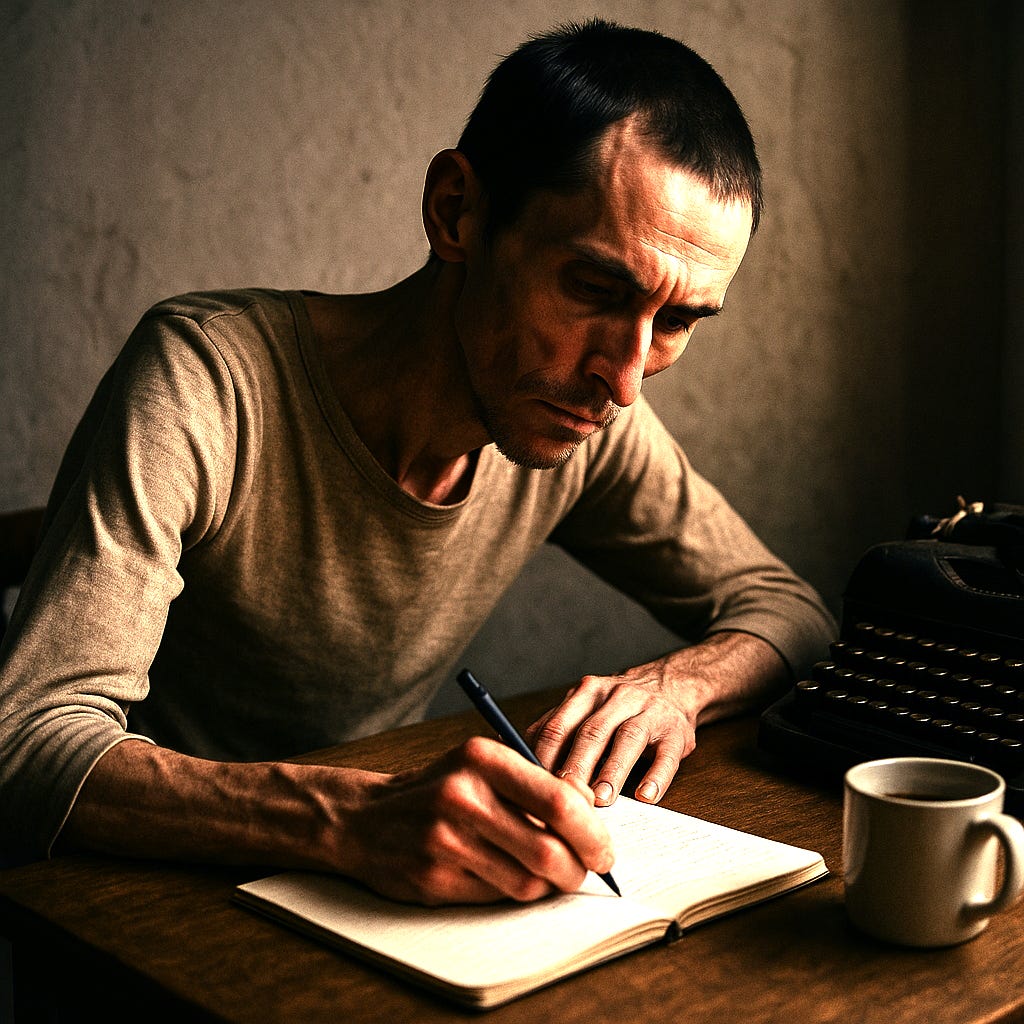
Asceticism as Artistic Method
You can react to this in two ways. The first is horror: how could anyone inflict such damage on their body for a role? The second is to see it as an artistic experiment. Bale turned his body into a canvas, a material to be shaped as deliberately as clay or stone in the hands of a sculptor.
In this sense, his work borders on performance art. Think of Marina Abramović, sitting motionless for hours while strangers interact with her body, or placing herself in situations of endurance and pain. Her art exists in the collision of will, body, and audience. Bale did something similar within cinema: he didn’t just play Trevor Reznik, he became him—physically, totally.
What fascinates us is authenticity. We aren’t seeing makeup, CGI, or prosthetics. We are seeing a body that has actually been stripped of its reserves. That raw truth creates a weight no illusion could ever replicate.
Writing as Asceticism
So what does this have to do with writing? More than you might think.
Writers, too, are no strangers to ascetic practice. We shut ourselves away, we sacrifice sleep, we let days blur together in service of a manuscript that may never see the light of day. We cut distractions, we live on coffee and scraps of food, we starve other parts of our lives for the sake of a few hours with the page.
Bale’s starvation is an extreme mirror of the quieter forms of self-denial in creative life. Not hunger for calories, but hunger for focus. We pare away everything that doesn’t belong to the work. We strip sentences down to bone. We let our bodies ache in the process: tired eyes, sore backs, restless sleep.
The principle is the same: art demands something of the body.
Ritual
What made Bale’s project even more striking was how ritualistic it became. He has said that his “diet”—tuna, apple, coffee—turned into a daily mantra. No variety. No pleasure. Repetition.
Writers do something similar. Many of us cling to rituals: three pages in the morning, always with the same mug, always at the same desk. Ritual isn’t the most rational way to work, but it gives shape to chaos. Bale’s diet was his ritual. His body became his desk.
The actor’s asceticism and the writer’s routine meet in a shared recognition: creation isn’t only intellectual. It is physical.
Limits and Sacrifice
But where is the line? When does art become destructive?
Bale admitted the diet was not healthy. He has told others not to imitate it. Yet there is something almost mythic about the artist who sacrifices themselves for the work. We find it in writers who burn out over a book, in painters who live in poverty, in musicians who wreck their bodies with excess. There’s a romantic notion that suffering is the gateway to truth in art.
I don’t believe suffering is not required, but I do believe it can serve as a catalyst. Bale could have worn prosthetics, but the film wouldn’t have been the same. His sacrifice gave the role a visceral gravity the audience could feel. And that’s why The Machinist remains a cult film today.
For a writer, the question becomes: how far am I willing to go? Do I stay up all night for a chapter? Do I shut myself off from friends to finish a book? Do I let my body bear the cost of a text coming into being?
The Body as Text
Perhaps the most interesting way to read Bale’s transformation is to treat his body as a text.
His emaciated figure in The Machinist isn’t just flesh, it is narrative. Every rib, every shadow under his eyes, every hesitant movement is a word in a novel written into his body. The film allows us to read that living manuscript.
There is a parallel in writing itself: the art of subtraction. When we strip a paragraph down to its essentials, silence becomes as meaningful as sound. Absence becomes a form of expression. Bale’s “text” was written through everything he didn’t eat, everything he denied himself.
Aftermath
The irony is that immediately after The Machinist, Bale had to reverse course for Batman Begins. From skeletal ascetic to muscular superhero in less than a year. From monk to myth.
Writers know a version of this rhythm too. Months of solitary grind followed by bursts of publicity, readings, interviews. We swing from cloister to spotlight. Creative life is rarely balanced. It moves in extremes.
Lessons for Writers
So what can we, as writers, learn from Bale’s extreme experiment without emulating it?
Authenticity has a cost. To create something that feels true, we must accept a price: time, energy, or comfort.
Ritual sustains the work. It isn’t variety that carries us forward, but repetition and discipline.
The body matters. Writing isn’t separate from the body. Fatigue, posture and health shape the work.
Limits are necessary. Bale survived because he stopped in time. We, too, must know when to rest, to eat, to step away. Art without boundaries consumes the artist.
Conclusion
Christian Bale starved himself into a living skeleton to give audiences a truth no makeup could mimic. It was an artistic project that reminds us art doesn’t only live in the head or on the page, but in the body.
As a writer, I can’t look at that transformation without reflecting on my own work. Every book costs something: sleep, health, time, relationships. Bale took that to the extreme. Learn from his relentlessness: his willingness to push so far that the work became unforgettable.
Because in the end, we are all like Bale when we write: we let art shape us, we let the body carry the text, and we sacrifice a piece of ourselves so that others might read.