


In the book Skriveboka, in a section under The Creative Forces, a discussion is presented about what it means to be an author versus a writer, and what qualities characterize those who succeed in the art of writing.
This is a book that claims to open the gates of writing, but the hinges squeal in a tone only dogs and desperate debutants can hear. On page one, The Creative Forces introduces itself like a benevolent deity: Everyone can be an author. Put the crown on your own head. No one can stop you.
But this inclusivity turns out to be a rhetorical maneuver. Throughout the rest of the text, an invisible hierarchy is built, in which most readers will implicitly be placed in the category of “writer” rather than “author,” or worse: in one of the two problem categories of writers who will not succeed.
So, with the softness of a hand on your shoulder and the cruelty of a thumb pressing down, the text keeps tightening the circle until only a select few can breathe inside it.
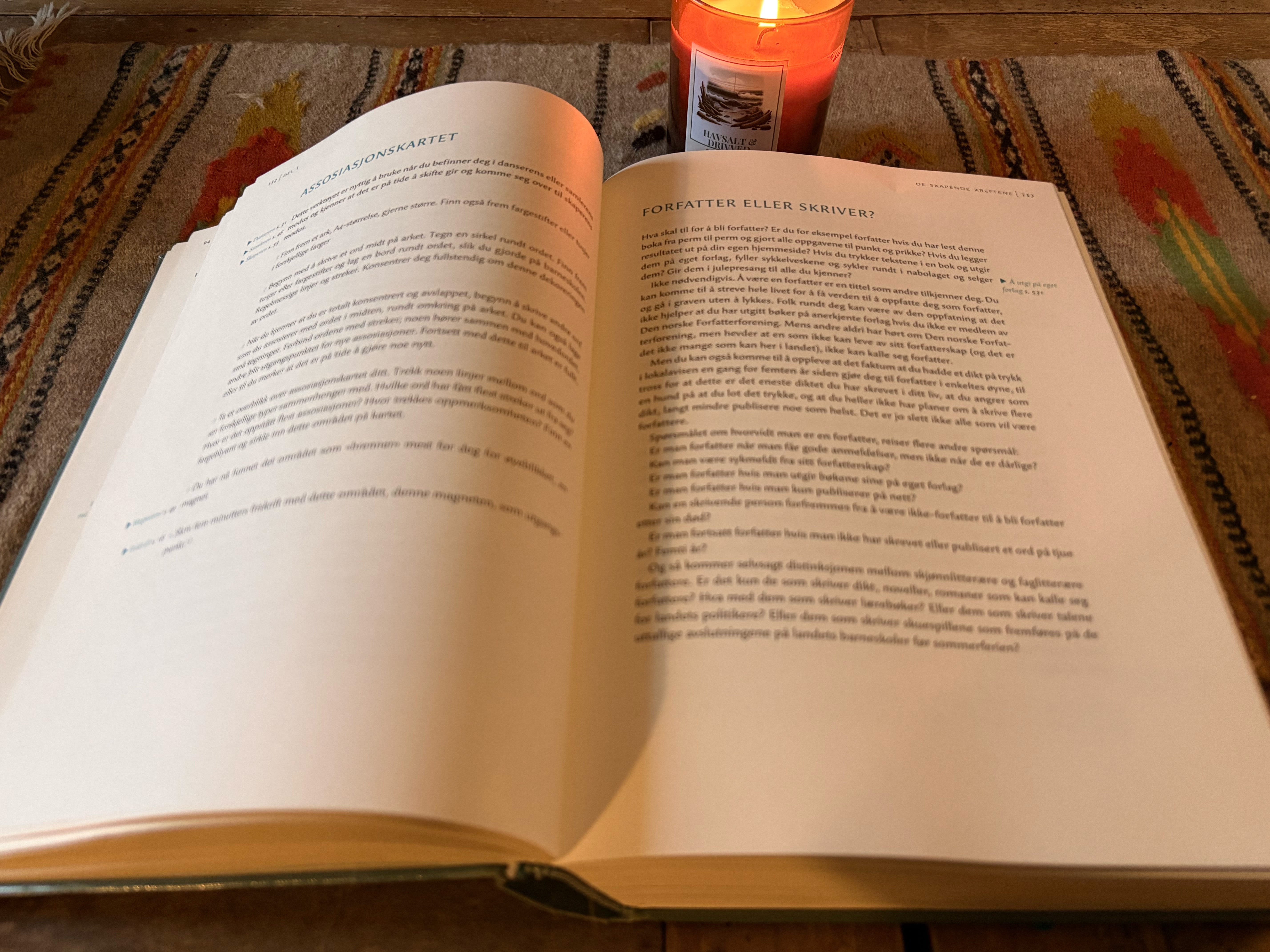
Author as a Self-Chosen Title
The book insists you can call yourself an author. Just do it. Declare it. Tattoo it. Whisper it in the mirror at 3 a.m. while your drafts rot in unseen folders.
This position is at its core radical and inclusive. It stands in contrast to an understanding of authorship as something one must earn through publications, recognition, or membership in professional associations.
But here’s the ting—it sounds radical, but only until the book slyly lays out a scavenger hunt of impossible questions:
Are you still an author if your reviews are bad?
If you self-publish?
If you publish online?
If you haven’t written in twenty years?
These questions suggest that authorship is not a fixed state but something more fluid and self-defined. More bluntly—it is an identity obstacle course built with tripwires and blind corners. The whole thing functions like one of those spiritual self-help riddles where the answer is: “You’ll know when you know,” which really means: “You probably don’t.”
Writers Must Be Readers, but Not the Wrong Kind of Readers
A central argument in the text is that being a good writer requires being a good reader. This is not merely a recommendation but is presented as a fact: “Being a reader and being a writer are closely connected.”
Writers must read. Everything. Anything. Homer and gossip columns, presumably with equal reverence. Pile the pages in your bloodstream until they echo in your prose like distant bells.
This is good advice, sure, but the tone hovers: If you read correctly, the right kind of literary ghost will eventually start haunting your sentences. If not, well… the silence speaks for itself, doesn’t it?
The Anatomical Markers of a “Real” Author
Here the book pulls out its microscope and pretends it’s a mirror. It describes the “true author”:
A fresh, childlike gaze.
An inner stubbornness.
A secret hotline to the creative forces.
These traits smell suspiciously like those personality quizzes where every answer is “Congratulations, you’re not special.”
These qualities are not presented as something one can develop through practice or learning, but as traits one either has or does not have. They are vague enough to be immeasurable yet so central that without them one apparently cannot become a “real” author.
This creates a form of esoteric exclusivity: authorship becomes something mystical, almost spiritual, accessible only to a chosen few. The book pretends to teach you how to write but subtly suggests that the truly important qualities cannot be taught.
The Editor’s Trap Door
Then we reach the red meat: the editor’s “secret test.”
The text reveals that publishing editors have an informal test when evaluating manuscripts. After reading and commenting on a text, giving opinions and advice, discussing possible directions for the work, the writer is asked to go home and revise.
Do what the editor says, and you’ve proven you’re not a real author.
Ignore what the editor says, and you’ve proven you can’t take criticism.
There appears to be a mythical third path — to find “something entirely different, and much better” — but this path is described in such mystical terms that it seems inaccessible to most. How does one know when one has found something “much better”? Who determines this? The editor who has already defined what is good?
The test is constructed so that the average writer is almost guaranteed to fail. Either they show that they lack “voice, soul, and subtext,” or they show that they are difficult to work with.
It’s not a test. It’s a trap door disguised as mentorship.
The Two Flawed Tribes of Writers
The book claims all aspiring writers fall into two categories:
Those with something to say but no voice.
Those with a voice but nothing to say.
An elegant, brutal binary. Almost poetic in its hopelessness.
If you’re reading the book, congratulations: the author has already placed you in one of these holding pens. Your deficiency is predetermined. And the text whispers that it might be permanent.
Circular Definitions and Tautologies
The text is filled with circular arguments:
An author is someone who “has found their voice.”
How does one know one has found their voice? By writing texts with “voice, soul, and undertext.”
How does one know the text has these qualities? By being recognized as an author.
This is a tautology: one is an author because one has the qualities authors have, and one knows one has these qualities because one is an author. There are no objective criteria, no concrete exercises, no clear path forward.
Gatekeeping Disguised as Guidance
Perhaps the most problematic dimension of the text is how it functions as a subtle form of gatekeeping — guarding the gates of authorship.
On the surface, the text offers inclusion: “Anyone can call themselves an author!” But through countless caveats, mystical qualifications, and hidden tests, it actually establishes barriers.
The reader is told that:
Most writers lack either voice or material
Most will fail the editor’s test
True authors have something innate, something childlike, something that cannot be learned
The result is that the reader will likely doubt themselves: “Do I really have contact with the creative forces within me? Do I have that innate stubbornness? Or am I just one of the many writers who will never become a real author?”
The Rhetoric of “Inner Censors” and Shame
Especially problematic is how the text describes those who “struggle with a strong inner censor” and who “cannot tolerate being bad for a while.” This is presented as a weakness, almost a character flaw.
But aren’t these precisely the readers who would benefit most from a book about writing? Those who are uncertain, who doubt themselves, who need encouragement and concrete tools?
Instead of meeting this uncertainty with care and practical guidance, the text pathologizes it. If you struggle with inner criticism and shame, the book implies, the problem lies within you — not in the system, not in the exclusionary definitions of authorship, not in the lack of support and resources.
This is a painful experience for the reader, and the text acknowledges this, but offers no way out. On the contrary: by linking shame to a lack of talent, the reader’s sense of inadequacy may be reinforced.
Conclusion
The Creative Forces presents itself as an essay that seeks to democratize authorship and help anyone who wants to write. But upon closer analysis, it functions as a subtler form of gatekeeping.
Through mystification of authorship (the “creative forces,” the “childlike gaze”), impossible tests (the editor’s double bind), and broad problem categories that encompass most readers, the text constructs a rhetoric in which most will implicitly be considered “not good enough.”
This is not necessarily the author’s conscious intention. It may reflect a genuine desire to distinguish between craft and art, between technique and talent. But the effect is the same: the reader leaves the text feeling that authorship may not be for them after all — not because they lack concrete skills they could learn, but because they supposedly lack something mystical, innate, inaccessible.
A genuinely inclusive writing book would give you tools. Exercises. Repeatable methods. A way out of the dark room.
Instead, The Creative Forces gives you incense and riddles. It performs equality while practicing selection.
It leaves the reader with the quiet suspicion that maybe, just maybe, the missing ingredient isn’t skill but destiny. And if destiny didn’t choose you, well… what were you doing reading this book in the first place?